



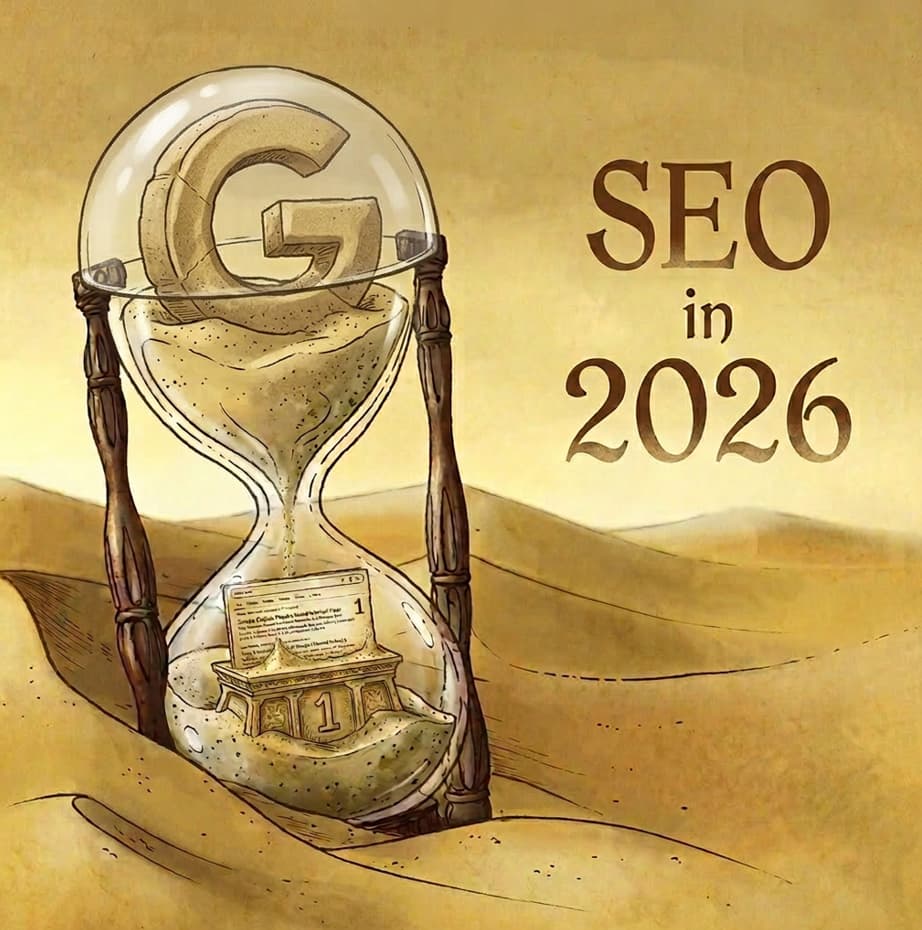
SEO in 2026
SEO in 2026 is about building real trust and authority through genuine business experience and clear communication so that search engines and people recognize your website as a credible source.
Contrary to popular belief, it is not about chasing keywords and backlinks anymore as much as demonstrating real-world expertise, brand credibility, and meaningful content that reflects the depth of your business.
This is because search engines must protect users from misinformation in a world where AI can easily generate content that appears expert but lacks real experience.
Therefore, for SEO to work in 2026, it needs to include:
- Demonstrated experience — content written from real industry knowledge and actual work performed
- Clear website structure — logical heading hierarchy (H1–H6) that helps search engines understand the page
- Content that communicates with people first — writing that resonates with real customer needs and questions
- Strong E-E-A-T signals — experience, expertise, authority, and trust reflected across the website
- Local business legitimacy — consistent Name, Address, and Phone (NAP) information across the web
- Quality local citations — mentions on relevant local websites rather than spammy directories
- Intent-driven content — pages that address the real question behind a keyword, not just the phrase itself
- Continuous monitoring — tracking rankings and improving pages based on real search performance
- Owning a niche — becoming the most credible source within a specific segment of the market
Test Your SEO Readiness For 2026
Is your website prepared for SEO in 2026? Take our quick readiness quiz to evaluate five strong SEO signals that help visibility in modern search: human content, AI discoverability, conversational optimization, E-E-A-T credibility, and brand authority.
Check the boxes that apply to your website to see how competitive you really are.
What Your Score Means
4 to 5: Strong SEO foundation for 2026. 2 to 3: Competitive but vulnerable to algorithm shifts. 0 to 1: At risk of losing visibility as AI-driven search evolves.
Is SEO Still Worth Focusing on In 2026?
Some might believe that SEO is not worth it in 2026 because AI overviews, featured snippets, and Large Language Models like ChatGPT are changing the way people search. It’s true that search is evolving; however, SEO is actually worth focusing on more because of it. All of these systems rely on information pulled from credible websites in the first place.
By optimizing for SEO, it becomes easier to get found on these other search surfaces, and even if they result in no clicks, they still increase brand awareness. Moreover, zero-click results are mostly tied to informational searches. For transactional searches—such as people looking for products or services—the presence in all these search experiences will still result in interactions with websites.
Therefore, SEO is still worth focusing on in 2026, and that’s why businesses hire local SEO services to help them get found online. These services have evolved from simply purchasing backlinks, to creating campaigns that establish the business as a credible source that both search engines and AI systems reference.
10 SEO Trends in 2026
There are many SEO trends in 2026 that involve adapting your website so both search engines and AI systems can clearly understand, trust, and present your business as the best answer. Knowing these trends will help businesses remain visible even as search evolves beyond traditional search and into AI summaries, featured answers, and conversational search experiences.
As SEO changes, it’s important to focus less on chasing rankings alone and more on becoming a truly helpful source that people can use for information and services.
Below are 10 SEO trends in 2026 you need to know about.
- AI Overview Optimization (AIO): Structuring content so it can be summarized and cited inside Google’s AI-generated search results.
- Answer Engine Optimization (AEO): Designing content to directly answer questions in AI assistants, voice search, and conversational search tools.
- Featured Snippet Targeting: Structuring pages to win Google’s answer boxes and position-zero results.
- Conversion Rate Optimization (CRO): Improving the percentage of visitors who become leads or customers once they reach your website.
- Experience-Based Content: Using writers and experts with real-world experience instead of generic AI-generated content.
- E-E-A-T Authority Signals: Demonstrating expertise, credibility, and trustworthiness across your entire website.
- Search Intent Mapping: Creating content that answers the reason behind a search, not just the keyword itself.
- Local Authority Building: Strengthening local trust signals like citations, reviews, and location-relevant content
- Structured Content for AI: Organizing pages so AI systems can easily extract answers and information.
- First-party Data: Tracking rankings and adjusting strategy before competitors overtake you.
AI Overview Optimization (AIO)
AI Overview Optimization focuses on structuring your content so it can be summarized and cited in Google’s AI-generated answers at the top of search results. AI Overviews now appear in a growing number of searches and often provide direct answers before users ever scroll to traditional search results. Studies show that AI summaries can significantly reduce clicks for informational queries, which means the goal is not just ranking but being included in the AI-generated explanation itself.
To optimize for AI Overviews, pages should clearly explain concepts, include concise definitions, and organize information logically using headings and structured sections. Content that demonstrates expertise and provides complete explanations tends to be favored by AI systems. Businesses that appear in these summaries gain visibility even when users do not click through to the website. In many cases, this exposure builds brand recognition before a user ever visits the site.
Answer Engine Optimization (AEO)
Answer Engine Optimization focuses on optimizing content for AI assistants, conversational search tools, and voice queries. Instead of scanning lists of links, users increasingly ask full questions and expect immediate answers. AI systems like ChatGPT, Gemini, and Perplexity generate responses by pulling information from credible websites across the internet.
AEO involves writing content that clearly answers common questions in a structured format. This often includes question-style headings, concise explanations, and clearly defined sections that allow AI systems to extract answers easily. Businesses that provide clear, authoritative explanations are more likely to be cited in AI-generated responses. Over time, being referenced by these systems strengthens both brand visibility and perceived expertise.
Featured Snippet Targeting
Featured snippets are the highlighted answer boxes that appear at the top of Google search results. These boxes display a short excerpt of content that directly answers a user’s question. Winning a featured snippet often means appearing above the traditional number-one ranking result.
To target featured snippets, content should include direct answers near the top of relevant sections, followed by a deeper explanation. Lists, step-by-step instructions, and clearly defined definitions are particularly effective formats. Structuring headings as questions also increases the chances of capturing these positions. When done correctly, featured snippets allow a website to dominate the most visible area of the search results page.
Conversion Rate Optimization (CRO)
Conversion Rate Optimization focuses on turning website visitors into leads, customers, or subscribers. While SEO brings people to a website, CRO determines whether those visitors actually take action. In 2026, successful SEO strategies increasingly focus on what happens after the click, not just the traffic itself.
CRO improvements often involve refining calls-to-action, simplifying page layouts, and making it easier for visitors to understand the value of a service or product. Testing different page elements, messaging, and layouts can significantly improve conversion rates. Businesses that combine SEO traffic with strong CRO strategies often generate far more revenue than those that focus solely on rankings.
Experience-Based Content
Experience-based content emphasizes writing from real-world expertise rather than relying solely on generic AI-generated information. As AI tools become capable of producing vast amounts of content, search engines increasingly prioritize information that reflects genuine experience and insight.
Content written by individuals who actively work in their industry often contains details, examples, and perspectives that generic articles lack. This kind of writing builds credibility with both readers and search engines. Businesses that showcase real experience through case studies, stories, and expert insights create stronger authority signals across their website.
E-E-A-T Authority Signals
E-E-A-T stands for Experience, Expertise, Authoritativeness, and Trustworthiness. These signals help search engines determine whether a website deserves to rank for a particular topic. In a digital landscape flooded with AI-generated content, E-E-A-T has become one of the most important ranking considerations.
Websites strengthen these signals by showcasing author credentials, publishing high-quality content, earning reputable mentions, and maintaining transparency about who is behind the business. Clear contact information, reviews, and consistent brand presence across the web also contribute to trust signals. When search engines see strong E-E-A-T indicators, they are more confident presenting that business as a reliable source.
Search Intent Mapping
Search intent mapping focuses on understanding why someone searches for something rather than simply targeting specific keywords. Every search query represents a need, whether that need is to learn something, compare options, or purchase a product.
Modern search engines are increasingly capable of identifying intent and matching results accordingly. This means successful SEO strategies often involve creating content tailored to specific stages of the customer journey. Informational guides attract early-stage research queries, while service pages target transactional searches. Aligning content with user intent improves both rankings and engagement.
Local Authority Building
Local authority building focuses on strengthening the signals that prove a business is legitimate within a specific geographic area. This often includes creating city-specific content that is genuinely helpful. For local companies, this often provides a significant advantage over national competitors.
Key signals include consistent business listings, strong customer reviews, and mentions on local websites or directories. When a business appears consistently across trusted local sources, search engines gain confidence that it truly operates in that region. For service-based businesses, building strong local authority often leads to higher rankings in location-based searches.
Structured Content for AI
Structured content involves organizing information so both search engines and AI systems can easily interpret it. Clear heading hierarchies, well-defined sections, and logical page structures make it easier for algorithms to understand what a page is about.
AI-driven search systems increasingly rely on structured content to extract and summarize information. Pages that clearly define concepts, provide concise explanations, and maintain logical formatting are more likely to be referenced in AI answers. Structured content not only improves rankings but also increases the likelihood that information will appear in AI-generated summaries.
Continuous SEO Monitoring
Continuous SEO monitoring focuses on tracking rankings and performance so businesses can respond quickly to changes in search visibility. SEO is not a one-time task but an ongoing process of improvement and adaptation.
By regularly reviewing keyword positions, traffic patterns, and competitor activity, businesses can identify opportunities and problems early. This allows them to update content, improve pages, and strengthen weak areas before rankings decline significantly. Companies that consistently monitor their SEO performance tend to maintain stronger long-term visibility than those that set up their website and forget about it.
You can use our free Google Rank Checker to see where you appear on search results.

SEO Tips in 2026
It’s important to understand that SEO in 2026 is about building E-E-A-T, and much of that has to do with real people. For example, having an established business with reviews, a physical address tied to the business, and most importantly, a known presence in the local market, shows a strong entity worth ranking.
Search engines like Google are responsible for providing billions of people with accurate and true information. Therefor, optimizing for people is arguably the best SEO tip to remember in 2026. Google itself has stated that content should be created for people, and not to sway search engines. Other tips include:
- Making sure NAP (name, address, phone number) is present and consistent throughout the website
- Providing people-first content that actually provides answers and solutions
- Optimizing Google Business Profile and getting more reviews
- Actively posting on LinkedIn, Reddit, Instagram, YouTube, and other platforms
- Garnering high-quality citations and backlinks
Customers, reviews, a physical address tied to the business, and most importantly, a known presence in their local market are as important as keywords, content, and backlinks. When a business has deep roots in its city, it signals E-E-A-T (Experience, Expertise, Authoritativeness, and Trustworthiness), which is arguably the most important aspect of SEO in 2026.
The truth about SEO in 2026 is that things like keywords, backlinks, and on-page optimization matter less than having an established business. There’s a reason some companies rank on page one without doing much work on their website. What they already have is trust and authority, built from years of proven experience in their industry.
This is because the entire business model of search engines is to provide users with accurate and true information. In a world where AI can mimic expertise, E-E-A-T is the only thing standing between honest and transparent disclosure, and the businesses that have established themselves in a post-AI world have an advantage because they built expertise in a time when it was hard to mimic.
A Final Word About SEO in 2026 From an Expert
I believe that it’s important to create a narrative—through writing—that wins the hearts and minds of people, and effectively brings the experience of your business throughout your entire website. Creating an authentic, original narrative is becoming harder because Artificial Intelligence is being used on a massive scale. As a result, articles, posts, and websites all tend to sound the same.
The best advice I can about SEO in 2026 is to be passionate about what you are doing, and not let automation tools take over your creativity entirely. Every individual is unique; therefore, every business and website should be unique too. In five years time, SEO will be about creativity, and creativity comes from the experiences people have.
No two experiences are the same, and experience is a human quality that Artificial Intelligence can talk about, but doesn’t have.
There’s a reason why Experience is the latest addition to E-A-T. Was it a coincidence? Or was that by design? I’ll let you decide.
Looking for SEO services that use the top strategies in 2026? We’ll build your E-E-A-T and help increase your visibility on traditional search as well as LLMs.
Calgary SEO Services