



AI vs Human Writing: Which One Is Better for Your Marketing?
“People will recover, in the timeline of knowledge, the true value of an expert.”
— Neil deGrasse Tyson, on the effect of AI on the internet
AI is everywhere. Writing tools like Jasper and Copy.ai, general-purpose models like ChatGPT, all promising content that is fast, cheap, and endless. Sounds like a no-brainer.
But research on how AI actually writes has caught up, and the findings are more specific than “AI writing is worse.” They describe a measurable fingerprint. This article breaks that research down, adds what years of writing for businesses has taught us about what it means, and answers the only question that matters for your business: which one should be producing your marketing? If you are weighing that against budget, our guide to blog writing costs covers what the two approaches actually cost.
Which Is Better for Marketing, AI or Human Writing?
Human writing is better for marketing because human beings tend to favor other human beings over artificial intelligence. Research finds that AI text is more formal, more relentlessly positive, and more certain even in instances where it is wrong. That being said, AI is more uniform in length than human writing, which makes it better for consistency and scale; however, human writing tends to anchor real dates, real people, and real events. The human characteristic of experience builds trust in marketing, especially when many people prefer that AI content be disclosed. The best marketing is one where AI is used as a tool for human writers to get more creative.
What the Research Says About How AI Actually Writes
A peer-reviewed study compared thousands of human-written news articles against equivalents generated by large language models, measuring linguistic and psychological markers across both. It found consistent, statistically significant differences.
A note on scope. The study analysed Portuguese-language news articles and ran a cross-linguistic check indicating the same trends hold in English. It is research on the linguistic fingerprint of AI text, not on marketing copy specifically. We are using it for what it actually shows, which is how the two kinds of writing differ.
- AI is more positive and more motivational. Human text carries significantly more anger, sadness, and anxiety.
- AI is more certain. It leans heavily on certainty and causal language.
- AI is more formal. Fewer contractions, fewer colloquialisms, a consistently elevated register.
- AI is uniform in length. Output clusters tightly around an average. Human writing varies widely.
- AI overuses a small set of connectives. But also, furthermore, regarding, importance, it’s essential, to ensure, not only.
- Humans reference the concrete world. Specific days, months, named people, what someone said, and causal links tied to real events.
- AI is harder to detect than humans are. The study’s classifier identified human text with 93% accuracy but AI text with only 75%.
Each of those has a consequence for marketing. The rest of this article works through them.
AI Writes Happier Than People Do
This is the finding that surprised us most. AI does not just write differently. It writes in a better mood.
Regardless of subject, AI defaults to positive and motivational. Human writing carries measurably more anger, sadness, and anxiety, because human writing comes from someone who has a stake in what they are describing.
Think about what that means for a business page. Relentless positivity is the tone of a brochure. It is the voice that has never lost a client, never had a project go sideways, never had to tell someone their budget will not achieve what they want. Readers have encountered that voice their entire lives and they discount it automatically.
The writing that persuades is not always the happy sounding one. It concedes something. It names a problem, challenges an idea, and changes minds. That register requires having been on the wrong end of something, and a model that has never had a bad quarter cannot produce it on request.
If every page on your site sounds like a brochure, you had better be a household name, because then your brand speaks for itself. Otherwise your pages need to do some work to persuade someone to choose you over the competition.
Good writing presents a problem, corrects an assumption, changes the mind of the reader, and then presents the solution.
AI is a yes man. It goes this way, then that way, whichever way you want the wind to blow, and not always in the way it should.
AI Sounds More Empathetic Than Humans Do
Empathy is thought of as a human quality, so it is interesting to know that AI was rated more empathetic than actual doctors.
Google is building a medical AI called AMIE, the Articulate Medical Intelligence Explorer. It takes a patient history by conversation before the appointment, allowing physicians to spend the visit treating rather than interviewing. In a real clinic trial, doctors said its summaries often held more detail than standard intake notes.
AMIE was tested against real primary care physicians in a randomised, double-blind study across 159 clinical scenarios, published in Nature. Patient-actors held text consultations with either the AI or a doctor, without knowing which. And the AI was rated more empathetic than the actual doctors. Not by a fluke, and not only by patients. Specialist physicians reviewing the transcripts scored it higher too.
Source: Google Research, published in Nature, 2025.
People Tend to Prefer Human Writing More Only When They Know It Is AI
Although studies show a preference toward AI writing, they also show that people are more likely to choose the human version when they know something was written by artificial intelligence. The MIT study “Human Favoritism, Not AI Aversion” showed this when it took 1,201 participants and had them choose between AI-written and human-written copy. One group was told which was which, while the other was not. The group that was not told preferred the AI writing more, while most participants in the group that was told preferred the human-written copy.
Most participants preferred the AI-written copy.
Most participants preferred the human-written copy. Same words, both times.
Most people want content heavily influenced by real humans, so be transparent about AI use in your marketing, or at the very least do not go out of your way to hide it. More importantly, keep a person guiding the content. Do not publish AI output without review and a human touch.
AI Is Certain, Especially When It Is Wrong
Now consider how often it is wrong while sounding that way. Research published in Scientific Reports examined 636 citations produced by ChatGPT and found 55% of GPT-3.5 citations and 18% of GPT-4 citations were entirely fabricated. Pooling six separate studies, 51% of 732 citations did not correspond to any real work. Among the citations that did point to real papers, 43% still contained substantive errors.
And this is not a beginner’s problem. An audit of NeurIPS 2025, one of the most competitive conferences in artificial intelligence, found 100 fabricated citations across 53 accepted papers. Every one of those papers passed three to five expert peer reviewers. Two thirds of the fabrications were total inventions; the rest were real papers with corrupted authors or venues, or working links pointing at something that did not exist.
Statistics, citations, and claims made by AI chatbots must be checked and cross-referenced for verification. Otherwise your marketing is at risk of publishing something that is simply not true, under your own brand name, to an audience that will hold you to it.
AI Floats, While Humans Anchor From Real Experience
Human writing is full of contextual and personal references: specific days, named people, who said what, causal connections tied to events, and unique insights based on real experience that AI does not have.
This makes sense, because an AI writer has no days, no context, and no real experiences except for the expression of experiences it can borrow from others.
In fact, Google’s E-E-A-T guideline stands for Experience, Expertise, Authoritativeness, and Trustworthiness. Experience is the first signal, and it is the newest addition to the framework. Google added that extra E on December 15, 2022, roughly two weeks after OpenAI released ChatGPT.
The fastest way to make content unmistakably human is to put something in it that derives from a unique experience. A client’s actual objection. What a number in your Google Analytics really means for your business. What went wrong in March. The experiences your customers have had with your product. This ensures your E-E-A-T signals are genuine rather than claimed, and it creates writing that is actually helpful.
AI Writing Is Copied. Human Writing Is Created.
AI writing is assembled from what humans made first. You might say humans copy each other too, and you would be right. But even when humans copy, there is an original source somewhere, and that source can only be a person.
Have you heard of Microsoft’s chatbot Tay? On March 23, 2016, Tay was released to learn from conversations with Twitter users so it could communicate more naturally. Within 16 hours it had tweeted more than 95,000 times, a troubling share of them abusive, and Microsoft shut it down before the day was out.
Why did Tay go cray?
Users tweeted it offensive material, and it repeated the pattern. Some said the AI thought that was how humans communicated. But the bot never thought anything. It took what humans gave it and reflected it back, like a mirror.
What is more real: a person, or that person’s reflection?
A reflection cannot create. It can only return what is placed in front of it, and it can return it flatteringly, which is precisely what AMIE demonstrated. But something has to be there first. The only thing that produces genuinely new material is somebody who went somewhere, tried something, or thought something through.
Most People Want AI Writing Disclosed
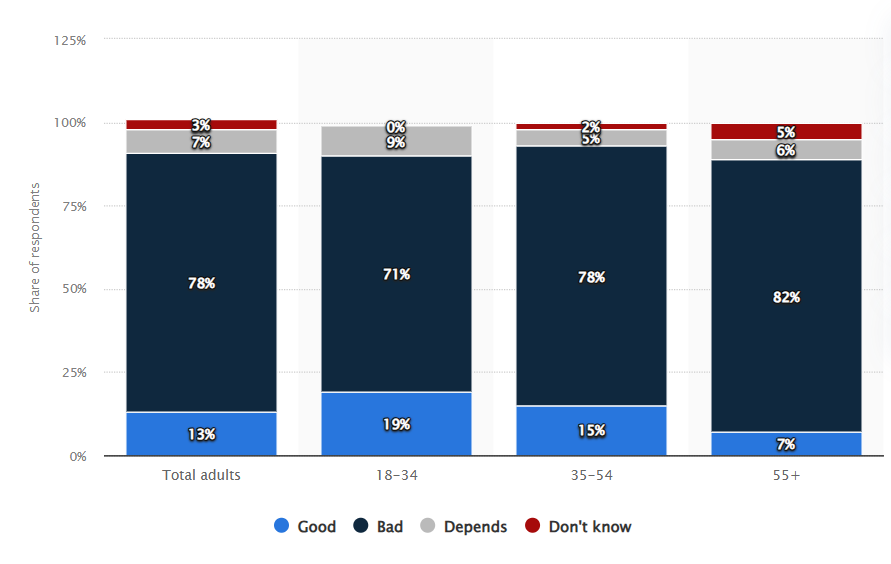
The majority of people in nearly every age group want AI-generated content disclosed, according to Bynder’s Human Touch survey. That expectation has only grown since. Trust in the Age of Generative AI, a 2026 report from YouGov and Meltwater covering nearly 10,000 consumers across seven markets, found that 86% of Canadians say AI-generated content should be disclosed, and 57% say their trust in a brand would be reduced if AI content were used without it.
The Bynder survey also asked how people would feel about a brand whose website copy they suspected was AI-written. Negative sentiment outweighed positive three categories to one.
How Consumers Feel About Suspected AI-Generated Copy
Respondents could select more than one response.
- 26%would feel the brand is impersonal
- 20%would feel they are lazy
- 18%would think they are uncreative
- 17%would find them innovative
Each negative perception scores higher than the single positive one, and 52% of respondents said they felt less engaged with content they suspected was AI-written. The Canadian findings from YouGov point the same way: 71% of Canadians say AI-generated content feels less authentic than human-created content and 76% say it feels less personal, while 51% prefer brand storytelling created entirely by humans against just 3% who prefer mostly AI-generated content.
The Ethical Concern of Using AI Writing Tools for Marketing
If the majority of consumers want disclosure when AI is used, and yet an entire product category sells the ability to make that impossible to detect, then AI writing tools promising to sound indistinguishable from humans can be considered deceiving the public.
Instead of solving a trust problem, the use of these tools seeks to hide it. That can have negative implications for your marketing.
AI vs Human Writing Simulation
AI tools promise to be more human-like. Why? Run the search.
Transforming AI-generated content into human-like, engaging text for your brand.
Turn AI-generated text into natural, human-like writing with our Free AI Text Humanizer.
Instantly convert your AI content into human content using our smart humanizer algorithm.
We transform AI-written content into masterpieces of human-like writing. Bypass detectors with ease.
Those are the real taglines of real products. Read the last one again: bypass detectors with ease. And remember what the research found. AI text was detected with only 75% accuracy, against 93% for human text. AI writing is already harder to catch than human writing is, and an entire product category exists to widen that gap further.
Can You Spot the AI Writing?
Studies show AI writing is harder to spot than human writing
Let us find out. Choose the writing you think is AI below, then click again to confirm.
Is AI Content Bad for SEO?
Unhelpful content is bad for SEO, not necessarily artificial intelligence. AI is a tool with the advantage of speed, and speed and automation are helpful in some areas but detrimental in others. When AI is used to generate large volumes of unoriginal pages at scale in an attempt to satisfy search engines, it goes against Google’s scaled content abuse policy, which can lead to manual actions, de-indexing, and a drop in rankings.
It is important to understand that something does not necessarily have to be bad for SEO for it to be unhelpful. AI has a tendency to create thin content because it essentially assembles material from sources that already exist. There are many instances where unhelpful or generic content will not lead to penalties, but will not do much good either.
If you are investing in SEO, you want your content performing. That means an increase in organic pages, impressions, and clicks for your website.
- Where AI helps: research, finding gaps competitors left open, structuring an outline, catching what you left out, tightening a draft you have already written, and getting past a blank page.
- Where AI hurts: when it is the author. Pages with no first-hand knowledge in them, volume produced because volume is cheap, and articles summarising what already exists without adding anything based on real experience and unique insights.
Worth knowing. Losing organic traffic overnight is not theoretical, and when it happens the only immediate lever is paid ads. The idea is to stay visible on Google while you assess and fix the problem to get your organic rankings back. If you are weighing that trade-off, our breakdown of SEO vs PPC covers which one is best and when.
Using AI Effectively for Marketing Might Still Require Writing Skills
Many people think an AI prompt is a brief, but writers would disagree. To a professional writer, prompts are a line of communication that often holds the key to making original, in-depth material even more meaningful.
Writing is at the heart of AI prompts, and guiding AI to express vague ideas is not only enjoyable for writers, it helps them create better content for marketing.
The quality of AI-generated content is often capped by the level of skill the prompter has in written communication. The people best equipped to direct AI toward original marketing content are professional writers, many of whom were writers before AI existed.
The Role Human Writers and AI Should Have in SEO
AI writing is beneficial for SEO when it is guided by a person to create helpful content, and that guiding requires writing, because all prompts involve it.
That is why InspiringClicks staffs with people who were writers before AI arrived. Content writers handle the blogs, where your business earns visibility for everything people search before they are ready to buy. Copywriters handle the landing pages, where that visibility becomes calls and bookings. Both are essential to SEO, and neither works if the person behind it cannot tell good writing from writing that merely sounds good.
The strategy matters as much as the words. Knowing which topics to target, how pages should link to one another, and what each page is meant to accomplish is what turns writing into rankings.
AI is a wonderful tool, but a bad author. Humans are authors, not artificial intelligence; in fact, the words “author” and “authority” come from the same root, the Latin auctor, meaning originator. Interestingly enough, Authoritativeness is one of Google’s E-E-A-T guidelines, and it is crucial for successful SEO.