


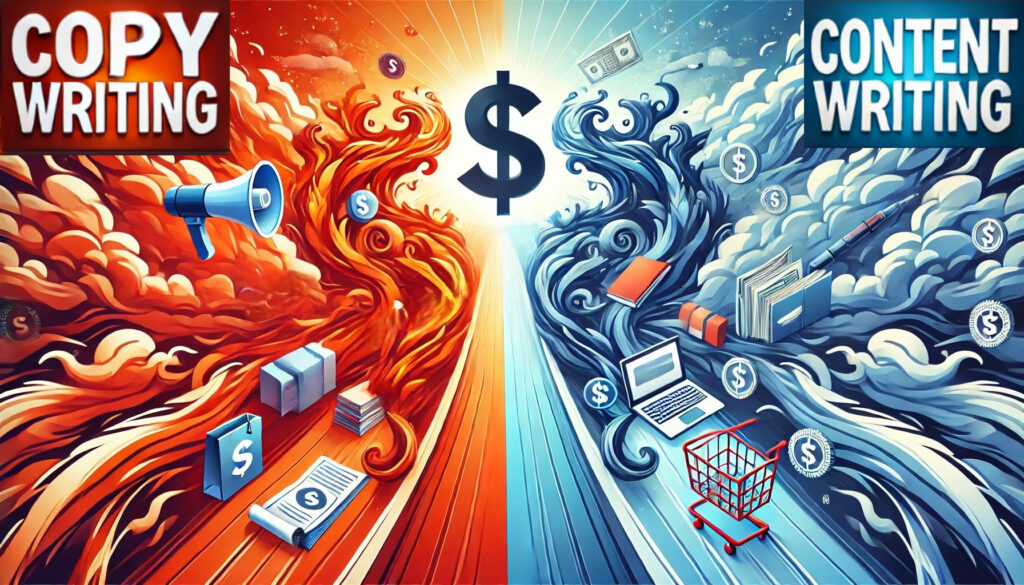
The Difference Between Copywriting and Content Writing
Both copywriting and content writing play an important role in marketing strategies such as Search Engine Optimization. Content can take many forms, but the goal remains the same: to turn attention into action. If your content drives conversions, bookings, and sales, it’s doing its job.
For that to happen, one of two things has to be true. Either there is a direct ask inside the content, or the content establishes enough authority that the ask speaks for itself. The first is copywriting. The second is content writing. Most of the time they need to work together, which is why we use copywriting inside our Calgary SEO campaigns rather than treating it as a separate service.
Did you spot the indirect pitch?
What you are reading right now has components of both. The question is not which one is better. It is which one a specific page needs, and that is decided by the reader rather than by you.
Copywriting is writing that serves a decision. The reader already knows what they want and needs friction removed so they can act, so the writing is built to persuade and is measured by conversion.
Content writing is writing that serves an information need. The reader has a question, and the writing is built to answer it completely, measured by visibility, trust, and the conversions it assists later.
The Distinction Is Intent, Not Funnel Stage
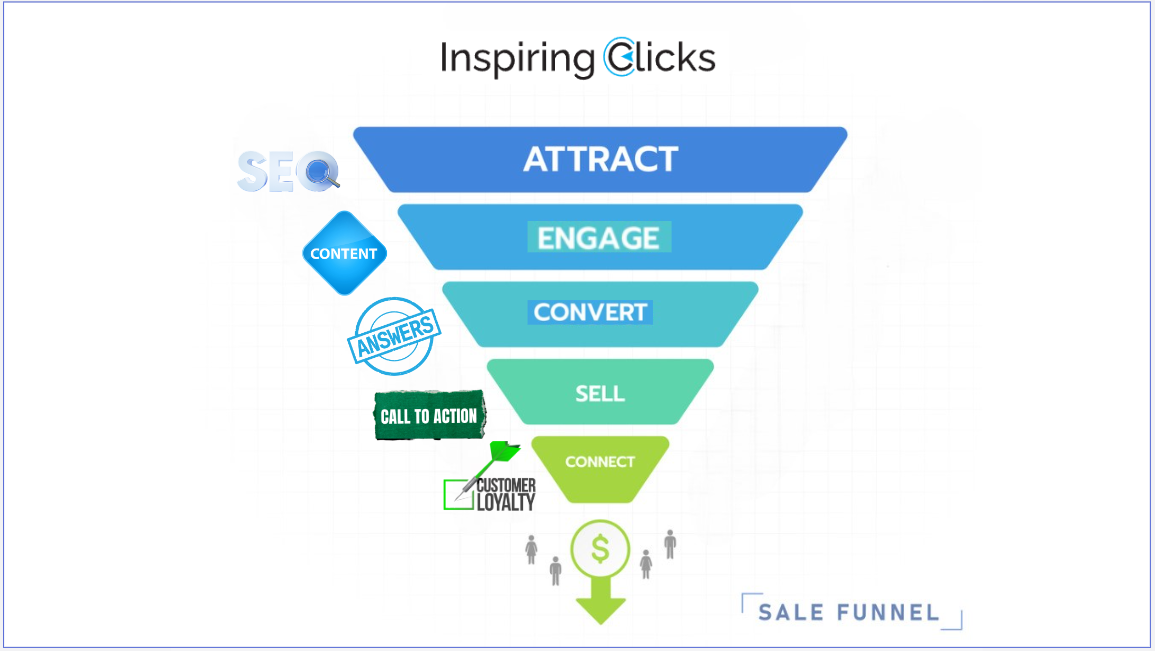
The common shorthand is that content sits at the top of the funnel and copy sits at the bottom. It is a useful starting point and it is not accurate. A cold ad is pure copywriting aimed at someone who does not yet know they have a problem. A detailed case study or a buyer’s comparison guide is content writing aimed squarely at someone who is deciding this week.
Both types of writing exist at every stage. What changes is what the reader came for.
The reader wants understanding, not a transaction. This calls for content writing.
“How do I fix a leaky faucet” · “What is AEO”
The reader has already understood the problem and is comparing options. This calls for copywriting.
“Best plumber near me” · “Hire an SEO agency”
How each one fails
This is the most useful diagnostic in the discipline, and it works in both directions.
Urgency, hard calls to action, and product mentions dropped into a page someone opened to learn something. The reader came with a question, got sold to instead, and left.
Twelve hundred words of industry background above a phone number, for someone who had already decided and only needed to know whether you serve their area.
If a page is underperforming, check that mismatch before you rewrite a single sentence.
Copywriting vs Content Writing: The FLIPS Breakdown
| FLIPS | Copywriting | Content Writing |
|---|---|---|
| Focus | Removing friction from a decision | Answering a question completely |
| Length | Anywhere from 10 words to a full landing page. Length follows the ask. | Typically 800 to 2,500+ words, however long the topic needs to be covered properly. |
| Intent | Drives one specific action | Builds the trust that makes the action credible |
| Placement | Ads, landing pages, service and product pages, email sequences, CTA sections inside blogs | Blogs, guides, glossaries, case studies, content hubs |
| Success metric | Conversion rate, cost per lead, form fills, calls | Impressions, rankings, time on page, assisted conversions, AI citations |
The difference between copywriting and content writing, broken down by FLIPS.
Length is also where the budgets diverge, because the two are priced on different things. If you are working out what the content side costs, we break the numbers down in our guide to blog writing costs.
Page Intent Diagnostic
Pick the three answers that describe the page you are planning. The meter shows roughly how the writing should split between content and copy.
When Should Copywriting Be Used?
Use copywriting when the page has one job and that job is an action.
That action is not always a purchase, and treating it as though it always is will cost you conversions. Copywriting drives any single, specific micro-action: downloading a guide, booking a demo, requesting a quote, joining a list, clicking through to the next step. The discipline is the same whether the ask is worth ten thousand dollars or an email address.
Copy is short because the reader is mid-decision, not because short is better writing. Someone comparing three providers will not read three paragraphs of background before finding out whether you are a fit.
Use copywriting when you are:
- Writing an ad, a landing page, or a service page
- Asking for any specific action, from a purchase to a newsletter signup
- Launching something new
- Writing the section of a blog post where you finally ask for the business
- Speaking to someone who is comparing options rather than learning the basics

When Should Content Writing Be Used?
Use content writing when the decision carries friction.
Some purchases are low stakes. A cheap product with free returns can be sold from a page alone, because the cost of being wrong is almost nothing. High-friction decisions do not work that way. Nobody hires an agency, signs a long contract, or commits a real budget on the strength of a sales page. They commit after consuming enough of your work to believe you know what you are doing.
That is what content writing produces: evidence. Every industry has a set of questions people work through before they are ready to buy, and answering them thoroughly is how a business stops being a vendor and starts being the authority. Google formalized the same idea in its E-E-A-T framework, which asks whether a page demonstrates real experience, expertise, authoritativeness, and trust. A page with nothing behind it can be perfectly optimized and still lose to one that teaches the reader something.
Use content writing when you are:
- Selling anything with a long or high-stakes decision cycle
- Answering the questions your customers work through before they buy
- Building authority in your industry
- Demonstrating first-hand experience rather than claiming it
- Targeting a query where the searcher wants an answer, not a checkout
What’s the Difference Between Copy and Content?
Copy asks for a specific action. It is a direct pitch.
Content is the canvas the copy sits inside: text, video, images, audio, and everything else you publish.
That is why copywriting is one word and content writing is two. All copy is content, but not all content is copy. Put the word “writing” after “content” and you have narrowed it to the written form that educates and informs, like the article you are reading now.
What Role Do Copy and Content Play in SEO?
This is where the distinction stops being academic. Copy and content do different jobs in a search campaign, and confusing them is one of the most common reasons a site ranks but does not convert, or converts but never gets found.
Content writing wins the visibility
Search volume is heavily weighted toward people who are not buying yet. SparkToro’s clickstream analysis of Google searches breaks down like this:
Source: SparkToro clickstream analysis of Google search intent.
Even on the most conservative reading, people looking for answers outnumber people ready to transact by a wide margin. Someone searching “how much does SEO cost in Calgary” is not signing a contract today. They are exactly the person you want reading your work six weeks before they do.
Content writing is what lets you appear for those searches at all, and it does structural work that copy cannot:
- Keyword coverage. A service page can realistically target a handful of terms. A content library can target hundreds of long-tail variations of the same intent.
- Topical authority. Search engines evaluate sites, not just pages. Covering a subject thoroughly signals that yours is a legitimate resource on it.
- Link acquisition. Nobody links to a service page. People link to the guide, the data, the explainer.
- Internal routing. Blog articles are how authority and traffic flow through a site toward the pages that convert.
Copywriting converts the visibility
Rankings are not revenue. A page can sit at position one and still fail, because ranking gets someone to the page and copy decides what happens next.
- Title tags and meta descriptions. Pure copywriting. They do not move rankings directly, but they decide which of the top ten results gets the click.
- Service and location pages. The pages you want ranking for buying-intent searches are copy pages first.
- Calls to action. The point where interest becomes a form fill or a phone call.
- Engagement signals. Weak opening copy sends people back to the results page, and pages that fail readers rarely hold their position for long.
Intent matching is the whole game
A common misreading is that search engines prefer educational writing to sales writing. They do not. Google ranks commercial pages first for commercial queries all day long. What it rewards is a match between what the query wants and what the page delivers.
That is why the intent question comes before the writing question. Put content writing on an informational query and copy on a transactional one, and both perform. Swap them and both fail, no matter how well either is written.
How AI Search Changes the Balance
Search is no longer only a list of blue links. AI Overviews, ChatGPT, Perplexity, and Claude increasingly answer the question outright and cite a few sources underneath. That changes what each type of writing is worth.
The intent mix inside AI tools is different too. A 2025 analysis of tens of millions of real ChatGPT conversations found informational intent at about 33% of prompts, well below its roughly 53% share of traditional Google searches, while transactional intent rose from under 1% to around 6%. People are not only asking these tools to explain things. They are asking them to get something done.
Language models pull from pages that define terms plainly, structure information into headings and tables, and show first-hand knowledge. Padded, keyword-stuffed content is not just unhelpful to readers now. It is invisible to the systems choosing which sources to quote.
When an AI answer satisfies most of the audience before they reach a website, the people who do click are further along and more valuable. The page they land on gets fewer visitors and a shorter window to make its case.
How InspiringClicks Uses Copywriting in SEO Campaigns
Copywriting is not a separate line item for us. It runs through the SEO work itself: the title tags that decide whether a ranking earns a click, the service pages built to convert buying-intent searches, and the CTA sections inside articles that route informational traffic toward a decision.
To create that copy, our agency sticks to the ABCs:
- AArticulate the pain points of your target.
- BBring your product or service forward as the solution.
- CCreate incentives at the points where a reader is most ready to act. These personalized calls to action consistently outperform generic ones in HubSpot’s conversion testing.
We apply the same split to our own site. The blog you are reading is content writing, built to answer a real question and earn visibility. Our service pages are copy. That combination is how InspiringClicks grew from a single page to over 1.13 million Google impressions.
Is This Post Content Writing or Copywriting?
Content writing, with a few deliberate exceptions. Its job is to explain the difference well enough that you can apply it tomorrow. The pitch is here, but it is earned rather than announced, because the decision it points to is a high-friction one.
If this were a copywriting page, it would be far shorter, more visual, and built around a single action instead of an explanation.