



E-E-A-T: Creating Helpful Content For People

Table of Contents
In 2014, Google coined the term E-A-T: Expertise, Authoritativeness, and Trustworthiness. E-A-T was the guideline that told quality raters how to judge the credibility of a page and the people behind it, because the spread of false or misleading information can be harmful. Eight years later, in 2022, it added another E: Experience. Interestingly enough, Experience came after, but is the first letter of the acronym. This begs the question: Why bother adding experience when expertise was already measuring how much someone knows about the subject? If you think you know the answer, read our article about SEO branding, but if you want to learn something extremely important about SEO, then keep reading, because this is the thing nobody cares to tell you about E-E-A-T:
In a world where anyone can use AI to sound like a trusted expert and build authority, Experience becomes the most valuable part of E-E-A-T. It is the one thing that proves there is something real behind the expertise and trust being presented. Authority earned through experience is authority people can trust. Without experience, authority can become misleading—even dangerous. AI has filled the internet with inexperienced experts. E-E-A-T seeks to correct that, with Experience at the forefront.
What is E-E-A-T
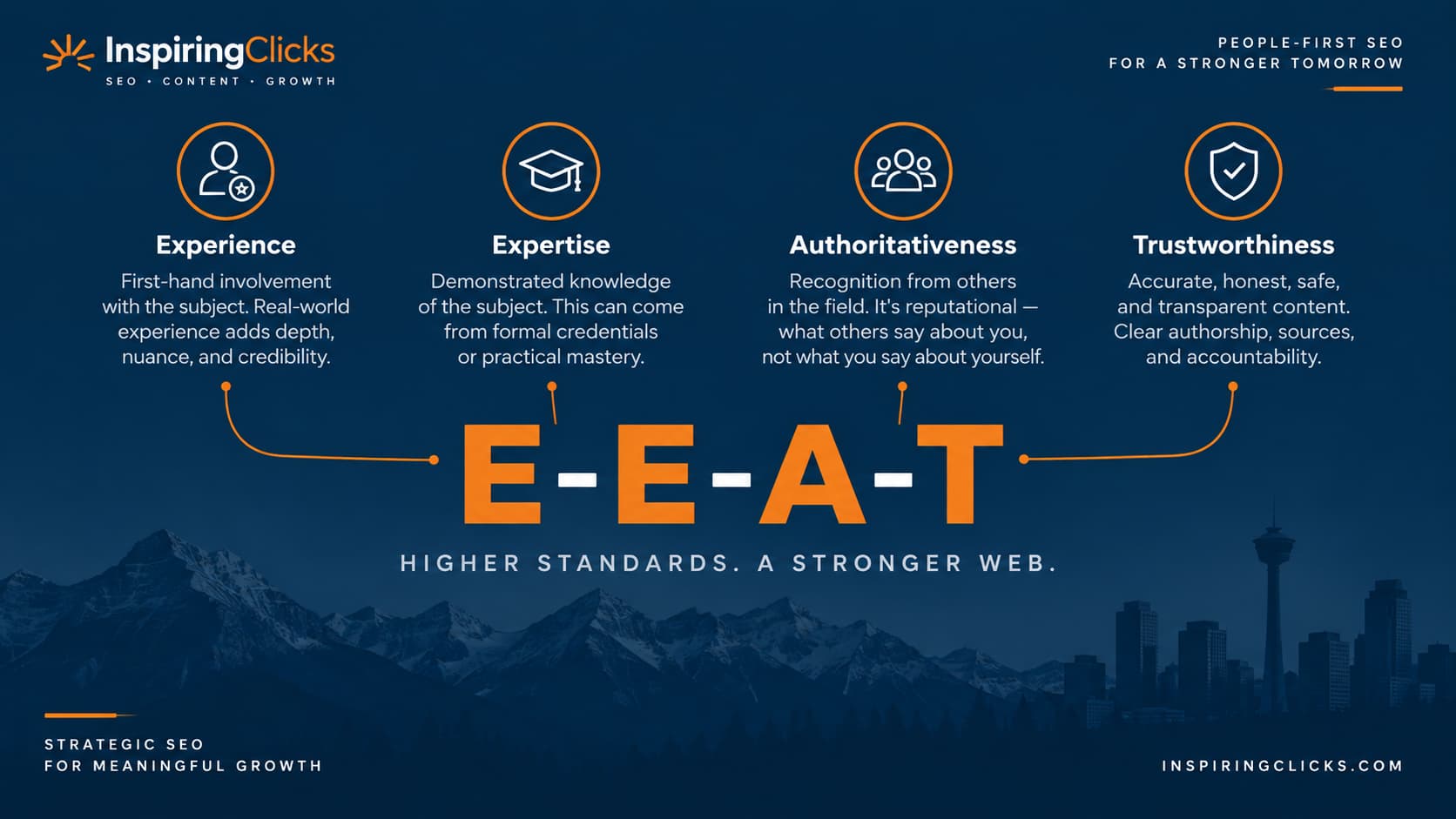
E-E-A-T stands for Experience, Expertise, Authoritativeness, and Trustworthiness. It is a framework in Google’s Search Quality Rater Guidelines — a set of criteria human raters use to assess the quality of search results. It is not a ranking factor and no algorithm scores a page on E-E-A-T directly. What it does is describe the qualities Google’s ranking systems are built to reward, which makes it a useful proxy for what strong content looks like.
Experience means first-hand involvement with the subject. The reviewer who actually used the product, the writer who took the trip, the practitioner describing a procedure they performed. Experience answers whether the author has lived the thing they are describing, not just researched it.
Expertise means demonstrated knowledge of the subject. For medical, legal, or financial content this usually implies formal credentials. For other topics it can be practical mastery — a hobbyist who has spent fifteen years restoring vintage motorcycles holds real expertise without a certificate to show for it.
Authoritativeness means recognition from others in the field. It is reputational rather than self-declared: citations, links from respected publications, industry coverage, professional references. Expertise is what you know; authoritativeness is who vouches for it.
Trustworthiness means the page and the site behind it are accurate, honest, safe, and transparent. Clear authorship, sourced claims, functioning contact information, secure transactions, disclosed affiliations. Google’s guidelines place Trust at the centre of the framework and describe the other three as supporting it — a page can be experienced, expert, and authoritative and still fail if it is untrustworthy.
What does E-E-A-T have to do with SEO?
E-E-A-T has everything to do with SEO because Google’s ranking systems are built to surface content that demonstrates these qualities, and its 180-plus pages of rater guidelines exist to teach human evaluators how to spot them. There are thousands of competing pages for any given search result. E-E-A-T is the standard that helps you build and audit content so that it earns a place among them rather than sitting unread on page four.
If a website is a homebase, and pages are rooms, then content is what fills them — the furniture. In fact, the word content derives from a Latin verb which means something that is held inside. People can visit a website — or enter a home — but without furniture (content), there is not much to do. They will leave.
E-E-A-T is what separates furnishing a room from simply putting things in it, so that a visitor finds what they came for and stays. Similar to how a chair nobody can sit in is decoration, not furniture — content without experience, expertise, authority, or trust occupies space without doing the job.
How Has E-E-A-T Changed?
For eight years, Google’s quality framework was E-A-T. Then in December 2022, Experience was added. The revision landed just two weeks after OpenAI released ChatGPT — too close together for one to have caused the other, but close enough that the industry has argued about it ever since.
What is not in dispute is what followed. Google’s Helpful Content Update had already arrived in August 2022, targeting content written for search engines rather than people. The September 2023 rollout and the March 2024 core update went considerably further; Google stated the goal of reducing unhelpful, unoriginal content in results by roughly 40 %. Rankings collapsed across large swathes of the web, and some publishers lost the majority of their organic traffic within weeks.
Many who were affected by Google’s content updates were flabbergasted as to why, but a quick look at their sitemap usually showed a huge spike in the number of posts published from December 2022 onward. Any SEO professional worth their salt can easily see that they were using AI to generate mass amounts of unhelpful content, which goes against Google’s ‘scaled content abuse policy’.
AI can sound like an expert. It can adopt the register of authority and, on a well-designed page, earn a reader’s trust. The one thing it cannot do is have been there. Experience is the element of E-E-A-T that a language model cannot manufacture, because it is the only one grounded in something that happened rather than something that was written. Trust remains the centre of the framework — Google is explicit about that — but experience has become the hardest of the four to fake, and therefore the most useful signal of a real person behind the page. Anyone can generate a thousand words on a topic. Only someone who has done the thing can tell you what the thousand words leave out.
How important is E-E-A-T for SEO?
Since E-E-A-T, it is arguably the most useful framework available for deciding what to publish. The information age is reaching saturation. There are many answers but few solutions — or rather, so many answers that the solutions among them become impossible to find.
The scale is documented. Ahrefs analysed 900,000 newly created web pages from April 2025 and found that 74.2% contained AI-generated content. Graphite, studying 65,000 English-language URLs, estimated that AI-written articles first surpassed human-written ones in November 2024 and accounted for 51.7% of its sample by May 2025. The same firm estimates more than 10 billion new AI-generated pages have been published since 2023.
Search Engine Optimization is about producing original, unique content that is helpful to a real person with a real question. Google’s scaled content abuse policy, introduced in March 2024, targets the practice of generating pages at volume primarily to manipulate rankings — regardless of whether a human, a machine, or both produced them. The policy is about intent and quality, not authorship.
E-E-A-T is the guideline that gives that distinction a shape you can work with. It tells you what a page needs to demonstrate before it deserves to rank: first-hand experience, real knowledge, external recognition, and a site a reader can trust. One who follows it is likely to do SEO in the way that earns rankings, rather than the way that chases them.
How Do You Actually Apply E-E-A-T to an SEO Campaign?
To make sure your content holds up against the standard Google’s raters are trained on, you should read the source material rather than the summaries of it. Read Google’s Search Quality Rater Guidelines and its guidance on creating helpful content, then keep current with core update announcements on the Search Central blog — the guidelines are revised without fanfare, and the industry commentary that follows is frequently wrong for the first week.
What to do
- Put a named author on every page, with a real biography. Not a byline. A biography that states what the person has done, where, and for how long, linked to a profile page that carries their credentials and other work. Anonymous content has no experience to demonstrate.
- Write from things you have done. The audit you ran, the campaign that failed, the client site that recovered. Specifics that could only come from having been present are the one signal that cannot be generated — a screenshot of your own dashboard outranks a paraphrase of someone else’s case study.
- Cite primary sources and link out to them. Link to Google’s documentation, the original study, the regulator’s page. Linking to a competitor who cites the study costs you nothing and demonstrates you read the underlying work.
- Date everything and maintain it. Publish dates, update dates, and an actual record of what changed. A 2019 article about ranking factors that has never been touched signals neglect regardless of how good it was.
- Build reputation off-site. Authoritativeness is conferred, not claimed. Industry citations, guest contributions, directory listings with consistent details, reviews, and mentions in coverage you did not write. Audit what the web says about you, not just what you say about yourself.
- Make the trust signals findable. Working contact details, a physical address where one exists, clear pricing, disclosed affiliate relationships, an author who can be verified elsewhere. For anything touching health, finance, or safety, treat this as the priority rather than the polish.
- Use AI as a drafting and research tool, then add what it cannot know. The published piece should contain judgement, experience, and detail that no model had access to.
What not to do
- Do not publish at volume simply because you can. Google’s scaled content abuse policy targets exactly that pattern, and it applies whether the pages were written by a person, a model, or both.
- Do not invent author personas or attach stock-photo bylines to content the named person did not write.
- Do not claim expertise you cannot substantiate, particularly in regulated fields.
- Do not treat E-E-A-T as a checklist to satisfy rather than a description of work worth doing. Raters and readers both detect the difference, and only one of them is scored.
- Do not chase individual core updates with tactical rewrites. The framework rewards accumulated credibility, which is slow by design.
What Nobody Cares to Tell You About E-E-A-T
Nobody cares to tell you that Experience may become the most valuable part of E-E-A-T because the quality of being human will become more valuable as AI makes information easier to create. When the internet starts to fill with content that can explain almost anything, lived experience becomes something people value because it cannot simply be generated. If search engines are there to satisfy people, then this gives them every reason to reward content that demonstrates a real person has actually done, seen, used, tested, or experienced what they are writing about.