


What Is SEO? A New Definition for A Drastically Changing Search Landscape
SEO — search engine optimization — is the ongoing process of shaping a website, and the wider digital footprint around it, so that people searching for what you offer actually find you and choose you. It is a process, not a project: the work repeats because search engines, competitors, and customer questions keep changing.
And here is the part most definitions skip. Although it is called search engine optimization, the work is not done for search engines. It is done for people. Search engines are simply the system that measures whether you did it well.
Ask ten agencies what Search Engine Optimization is and you will get ten versions of the same sentence about keywords and rankings. That sentence is not wrong, exactly. It is just about fifteen years out of date, and acting on it in today’s world is one of the more expensive mistakes a business can make.
This blog is the long answer. What SEO actually includes, why the distinction between optimizing for engines and optimizing for people is the whole ballgame, what happens when people use AI to generate content at scale, how the discipline changed more in the last five years than in the twenty before it, and where the honest line sits between what you can do yourself and what is worth paying for.
What SEO actually includes
SEO is a bundle of related work, not a single task. Here are the pieces. They are numbered for readability, not because there is a fixed order — what you tackle first depends entirely on the business in front of you.
-
Content strategy and creation
Deciding what the site should say, to whom, and in what order — then writing it. Not “publish weekly.” It’s about mapping the real questions your buyers ask and building pages that answer them properly. Understanding common content marketing challenges and solutions can help you avoid producing content simply for the sake of publishing.
-
Landing page optimization
The pages where money changes hands. Clear offer, clear proof, clear next step, fast load, works on a phone. Traffic to slow, unclear, or underperforming pages costs money.
-
Proof of concept
Real reviews, real case studies, real evidence that real work was done for real people. Proof of concept establishes clear trust signals to visitors, but also to search engines. Google wants to know it is connecting users with real services, and social proof essentially proves it.
-
Brand awareness, including AEO and GEO
Being visible where answers get assembled, not just where links get listed — AI Overviews, AI Mode, and assistants like ChatGPT, Gemini, and Perplexity. Answer engine optimization is how you get selected as that answer, and being a recognizable entity is now a search asset.
-
Relevant backlinks
The emphasis is on relevant. A guest post on a site your customers would actually read is worth more than a purchased profile of links that are spammy, and not relevant to your industry. More on why below.
-
Integrated marketing
Working the channels beside the website — Google Business Profile, social accounts, directories, listings, email. Google uses the entire digital landscape to evaluate your ranking authority, not only the website.
Search engine optimization has changed, and a big part of it now comes down to communication: words, messaging, blogs, landing pages, service descriptions, review responses — all of which solidify the business behind the website. That is not a coincidence, and it is the foundation of everything that follows.
Optimize for people, not for search engines
For years, the first rule in Google’s Webmaster Guidelines was to make pages primarily for users, not for search engines. Those guidelines have since been rewritten as Google Search Essentials, and the modern phrasing is even plainer — the top key practice is to create helpful, reliable, people-first content.
Google’s own documentation on creating helpful, reliable, people-first content spells out the distinction directly. Their ranking systems, they say, are built to prioritize information created to benefit people — not content created to manipulate rankings. And in the announcement of the 2022 helpful content update, Google noted that content made primarily for search traffic is strongly correlated with content searchers find unsatisfying.
SEO is a helpful activity when it is applied to people-first content, rather than search engine-first content.
— Google Search Central, Creating helpful, reliable, people-first content
That sentence is worth sitting with, because it reframes what SEO is. SEO is not the thing that makes content rank. It is what you apply to content that already deserves to rank. Skip the deserving part and the SEO has nothing to work with.
So if I had to define it in one line, here is mine:
SEO is the practice of portraying your real experience — across your website and the wider digital landscape — in a way that genuinely satisfies the person searching. Do that consistently and you build authority and trust. Rankings follow, because search engines have enough evidence to conclude you are an actual provider of a service, of knowledge, or of both.
Rankings are the receipt you get for paying the toll: people-first content, and a genuinely credible entity behind the website or page you are trying to rank.
What goes wrong when you optimize for the engine instead
The internet is full of forums where someone asks why their website suddenly lost its rankings. Pull up the sitemap on one of those sites and the answer is often visible in about eight seconds: five new posts a day, every day, for four months. Six hundred pages. Clearly possible now that AI can draft a thousand words in twenty seconds. Clearly unoriginal, thin, and scraped content.
Google has a name for it. Their spam policies define scaled content abuse as generating many pages whose primary purpose is manipulating rankings rather than helping users — large amounts of unoriginal content that adds little value, however it was created. The listed examples are almost a checklist of the modern playbook: using generative AI to spin out pages without adding value, stitching together content from other sites, and creating many pages that make little sense to a reader but happen to contain search keywords.
The neighbouring policy, doorway abuse, covers the other favourite: multiple pages or domains targeting specific cities or regions that all funnel visitors to the same place. Every business owner who has been sold “we’ll build you fifty city pages” has been sold this.
These are not old rules. Google introduced scaled content abuse, expired domain abuse, and site reputation abuse as three new spam policies in March 2024, describing them as bad practices they had watched grow in popularity. Read that as what it is: a direct response to what the web started doing the moment generative AI became free.
Search-engine-first
- Publishing on a schedule to hit a page count
- Pages built around a keyword before anyone asked the question
- Near-identical city or service pages with the nouns swapped
- Buying a backlink profile from a vendor you have never met
- No author, no address you can verify, no face
- Content that summarizes what everyone else already said
People-first
- Original, insightful words backed by real data — the best of it from first-hand, verifiable experience
- Pages that satisfy the question customers actually ask
- One strong page per genuine service or location you serve, avoiding needless saturation
- Links earned from sites that are genuine and relevant to your offer or industry
- Named people, real address, verifiable track record
People-first content has become one of the most important aspects of SEO, and it is the process of creating content to genuinely help people — whether that is providing knowledge, or providing a service.
Your SEO should address the overwhelming noise of the internet
Search engines have become very aggressive about filtering the real from the fake, and to understand why, you have to look at the volume of what they are filtering.
Ahrefs studied roughly 14 billion web pages and found that the overwhelming majority get no organic traffic from Google at all.
What happens to the average web page
Share of ~14 billion pages by monthly organic traffic from Google
Source: Ahrefs, study of ~14 billion pages. Ahrefs separately reports that only 1.74% of newly published pages break into the top 10 for any keyword within a year.
Ninety-six and a half percent of everything published is, functionally, invisible. That is the market you are entering.
There is simply too much spammy content because of AI; moreover, there is an overwhelming number of spammy backlinks. An audit of many small businesses will surface hundreds of spam links they never even asked for, pointing in from networks built entirely to sell rankings. Check the contact form and it is full of “hire me” pitches. Check the inbox and it is guest post solicitations from addresses that will not exist next quarter. Everyone wants a buck, and automation made the pitch free to send, which makes the sale even harder.
The situation of overwhelming noise from automation and spam is not one that only regular websites deal with. It is the same problem encountered by the largest indexation of knowledge on earth: Google. It is a problem Google is attempting to solve through helpful content indexing, through spam policies, and through core updates that reassess what deserves to be shown at all. Every one of those updates is an attempt to sort the genuine from the manufactured at a scale nobody else has to work at.
Which means the most useful skill in SEO right now is not keyword research. It is being able to tell the real from the noise — and then making sure that when a search engine looks at you, you land clearly on the real side.
How SEO has changed in the last 25 years
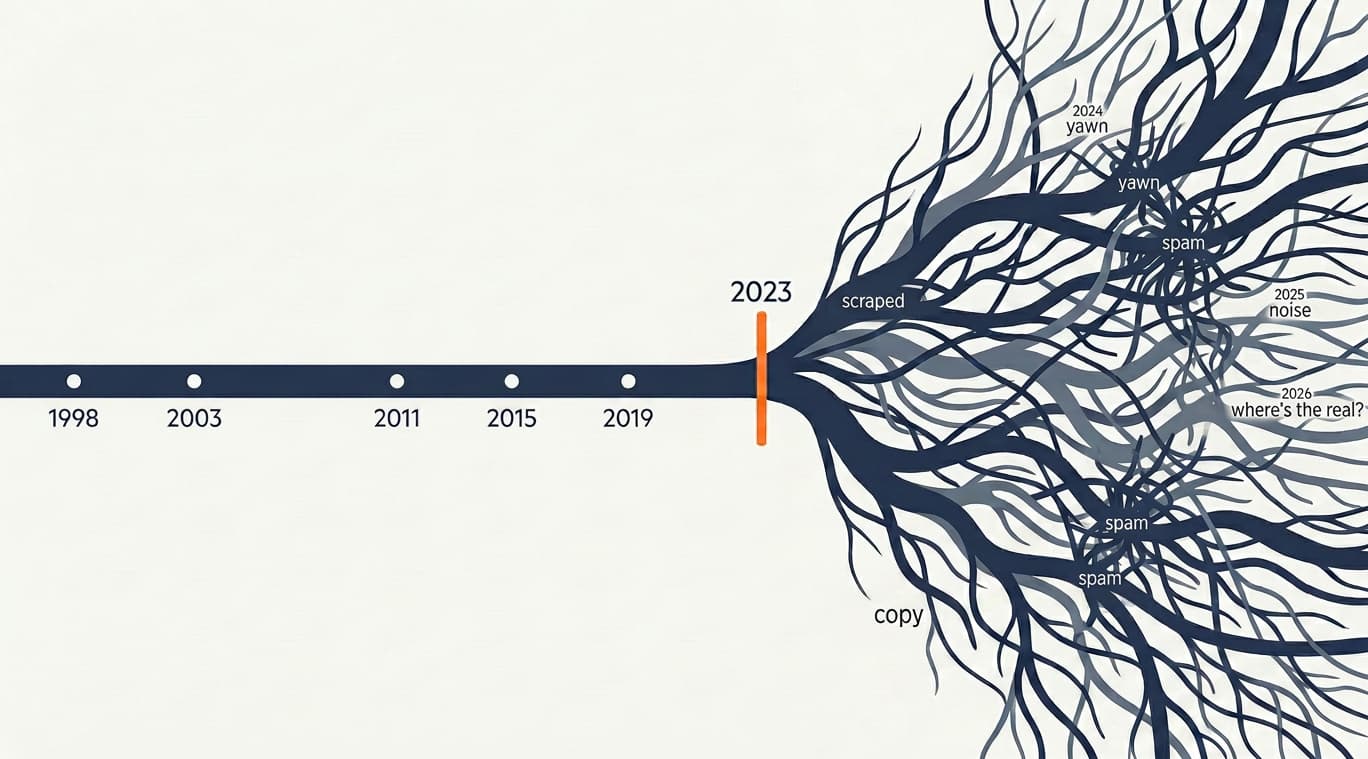
“What is SEO” is an evergreen question with a moving answer. The version of this article written in 2006 would have been about meta keywords and directory submissions. In 2016 it would have been about mobile and content marketing. Now, it is about AI Overviews, LLMs, and generative answer optimization. Here’s how SEO has changed in the last 25 years.
- The link-counting era — 1998 to 2010
- 1998Google launches with PageRank. Links are votes. The web is small enough that counting them mostly works.
- 2003The Florida update. Google’s first serious swing at keyword stuffing. Thousands of sites vanish overnight. SEO learns that rules change without warning.
- 2005The nofollow attribute and local search. Link manipulation gets its first countermeasure. Maps results start mattering for anyone with a storefront.
- The quality-filter era — 2011 to 2019
- 2011Panda. Targets thin and low-value content. The first clear signal that volume alone is a liability.
- 2012Penguin. Targets manipulative link building. The purchased-backlink business takes its first real hit.
- 2013Hummingbird. Google starts interpreting the meaning behind a query, not just the words in it. Entity and topic understanding begins.
- 2015RankBrain and the mobile-friendly update. Machine learning enters ranking. Phones overtake desktop.
- 2018The “Medic” core update. E-A-T — expertise, authoritativeness, trustworthiness — becomes the vocabulary everyone uses, especially for health and finance.
- 2019BERT. Natural language understanding at scale. Writing for a machine and writing for a person converge further.
- The rupture — 2020 to 2026
- 2020COVID. Everyone is at home and everything moves online at once. Search volume, e-commerce, and the number of businesses competing for the same local queries all jump simultaneously.
- 2021Page experience and Core Web Vitals. Speed and stability become explicit considerations. Technical health stops being optional.
- Aug 2022The helpful content update. Google starts systematically demoting content made for search engines rather than people.
- Nov 2022ChatGPT launches. Producing publishable-looking text becomes free and instant for everyone on earth. The web fills up.
- Dec 2022E-A-T becomes E-E-A-T. Google adds Experience — first-hand involvement. Timing is not accidental: it is the one thing a language model cannot fabricate.
- Mar 2024Three new spam policies. Scaled content abuse, expired domain abuse, and site reputation abuse, launched alongside a core update aimed at cutting low-quality content in results.
- May 2024AI Overviews launch. Announced at Google I/O on May 14. The answer moves above the links, and zero-click search becomes a structural problem rather than a talking point.
- May 2025AI Mode rolls out in the US. Conversational search with query fan-out — one question broken into many queries behind the scenes. Later expanded internationally in October.
- 2026Google publishes guidance for generative AI features and the industry settles on new acronyms: AEO (answer engine optimization) and GEO (generative engine optimization).
More has changed in search since 2020 than in the two decades before it. This is precisely why SEO is not a one-off project, but a process.
Where AEO and GEO actually fit into the new SEO
AEO and GEO refer to optimizing to be surfaced and cited by answer engines and generative systems, rather than only within a ranked list of search results. It is real work and it matters — assistants are now a genuine discovery channel, and being the source an AI reaches for is worth having.
But it is worth reading what Google itself says about it. In their guide to optimizing for generative AI features, the recommendation for AI visibility is to prioritize effective SEO strategies over what they call AEO and GEO “hacks,” and to create non-commodity content — unique, expert-led material that goes beyond common knowledge. Their guidance on AI features is blunter still: the foundational best practices for AEO and GEO are the same ones as for regular search, and there are no additional technical requirements to be eligible for citation in AI Overviews.
The practical read: there is no separate AEO checklist that substitutes for doing the work. Be crawlable, be indexed, be genuinely expert, be clearly attributable to a real entity. What has changed is not the requirement — it is how brutally the requirement for good SEO is now enforced, because an AI references trustworthy brands, just as Google ranks them.
All the noise is actually an advantage for the companies doing it right
Everything described so far — the volume of automated content, the spam networks, the sites assembled in an afternoon — sounds like a disadvantage. In practice, it is the opposite for any business willing to do the work properly, because the noise has made genuine businesses easier to recognize, not harder.
Consider what most of that noise actually looks like. There are now countless websites built entirely out of a keyword. The domain is the keyword. The company name is the keyword. There is no author, no photograph, and no verifiable address — sometimes a fabricated one. The entire site exists to persuade a search engine that a business is there, and with AI, a site like that takes an afternoon to produce.
That is the clearest example of creating for search engines rather than for people. But assume for a moment that it works: the site ranks, and visitors arrive. Ranking well and performing well are not the same outcome, and this is where the approach collapses.
A visitor landing on that page finds nothing to evaluate. There is no one behind the business, no evidence of work completed, and no trace of the company anywhere else on the internet. The absence registers immediately, even to someone who has never thought about SEO in their life, because people assess credibility before they assess an offer. Traffic to a page that cannot be trusted produces impressions and nothing else.
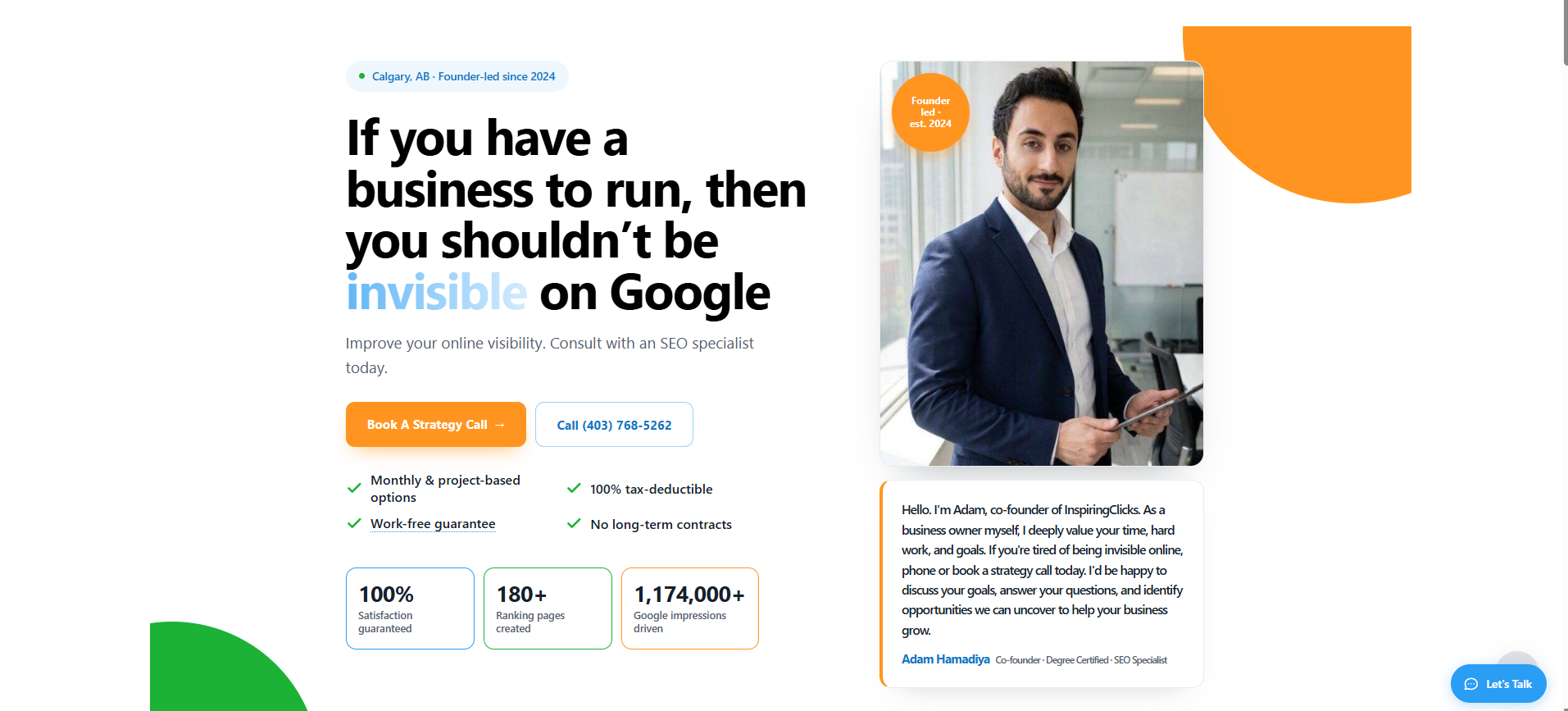
Now consider the inverse. My face is on this website. Search my name and you will find my work, my clients, what I specialize in, and what I offer — across multiple sources, not just my own domain. A prospective client can verify all of it in about ninety seconds. That verification is not a design preference or an exercise in self-promotion. It is proof of concept, and proof of concept functions as an SEO asset.
Google’s own framework describes the same thing in different language. E-E-A-T evaluates whether content demonstrates experience, expertise, authoritativeness, and trustworthiness, and their guidance asks directly whether content is presented in a way that makes a reader want to trust it — through clear sourcing, evidence of the expertise involved, and background on the author or the publisher. Each of those signals requires a real person or a real organization to point to. A keyword cannot supply any of them.
This is where the advantage becomes concrete. When the majority of what gets published carries none of those signals, supplying them genuinely is no longer table stakes — it is differentiation. The truer your communication, meaning the more accurately your website reflects what your business actually is, what you actually offer, who is behind it, and what you have actually done, the better positioned you are for a return. Not because search engines reward sincerity as a virtue, but because sincerity is the only reliable source of the evidence their systems are built to find, and the only thing that converts a visitor once they arrive.
Four ways to stay on the right side of this
- Put names and faces on the work. Author bios, team pages, real photos. Make yourself verifiable off your own domain too.
- Publish evidence, not adjectives. A case study with a real client, a real problem, and a real outcome beats a page of “industry-leading” every time.
- Write one page you would be proud to hand to a customer instead of ten built to catch variations of a keyword. If you would not send it to someone, do not publish it.
- Earn links by being worth linking to. A guest post for a related site, a genuine partnership, a piece of original research. Skip anyone selling you a package of a thousand links — that profile is exactly what shows up in the audits described above, and now it is pointing at you.
Can you do your own SEO?
Yes. You are free to, and you should start by trying.
Here is the honest complication. SEO is a process that takes time, and the people who already know how to do it are competing for the same first page you are. Business owners do not want to learn SEO. They want results. Those are different purchases, and it is worth being clear with yourself about which one you are making.
My actual advice: do it yourself first. Learn what the work involves. Fix your own titles, look at your own headings, see what you rank for now. You will either enjoy it and keep going, or you will discover exactly what you are paying someone to take off your plate — and either outcome is a win. If you do hand it off, pay someone trustworthy with real experience and a track record you can verify, and write it off as a business expense.
Three free tools to start with, no signup:
If you would rather have it handled
I run SEO campaigns for Calgary businesses — the strategy, the writing, and the technical work, done by the person you actually talk to.
The fastest way to find out whether SEO is worth it for your business is to ask. A strategy call is a quick, no-pressure conversation. Discuss your marketing with a specialist, ask your questions, and get clear next steps.
Calgary local line. Monday to Friday, 9 a.m. to 7 p.m., Saturday 9 a.m. to 5 p.m. If you would rather write than call, the request form takes about thirty seconds and we reply within one business day.