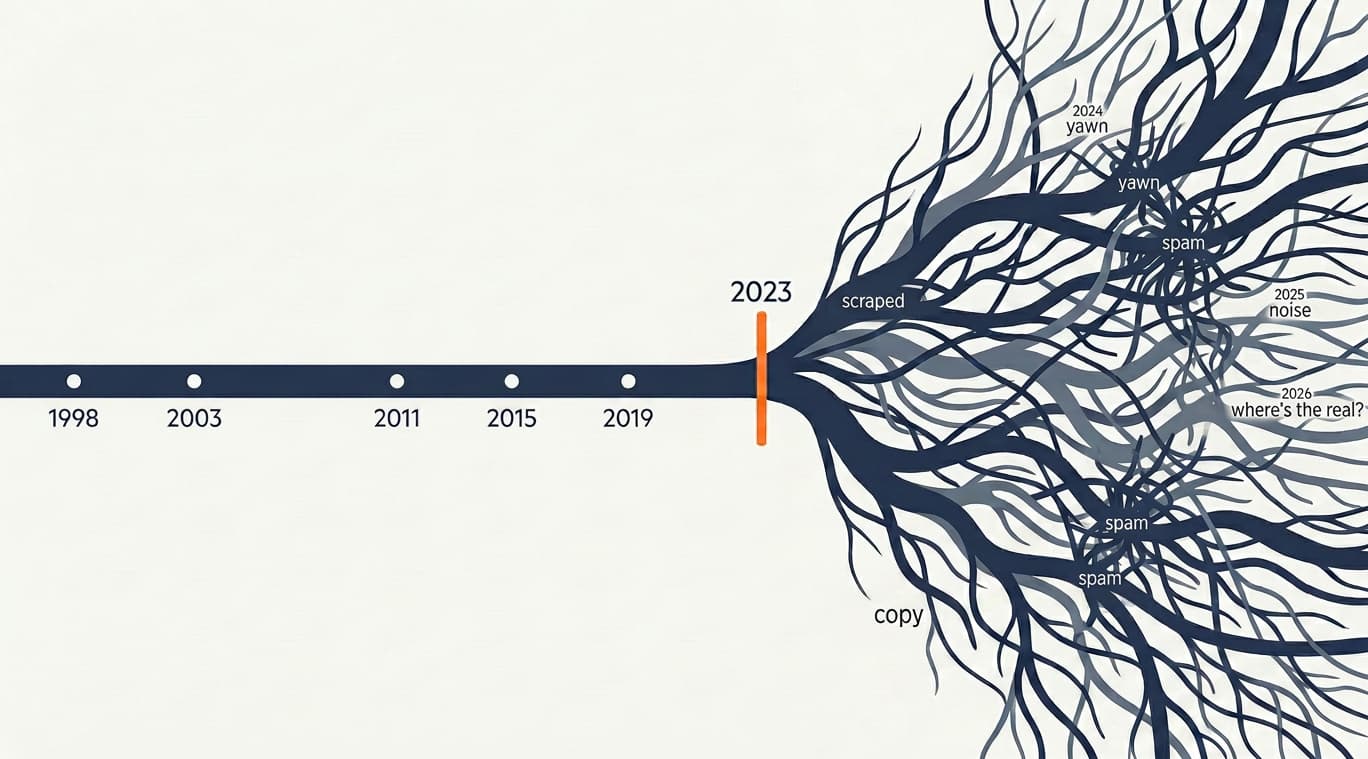



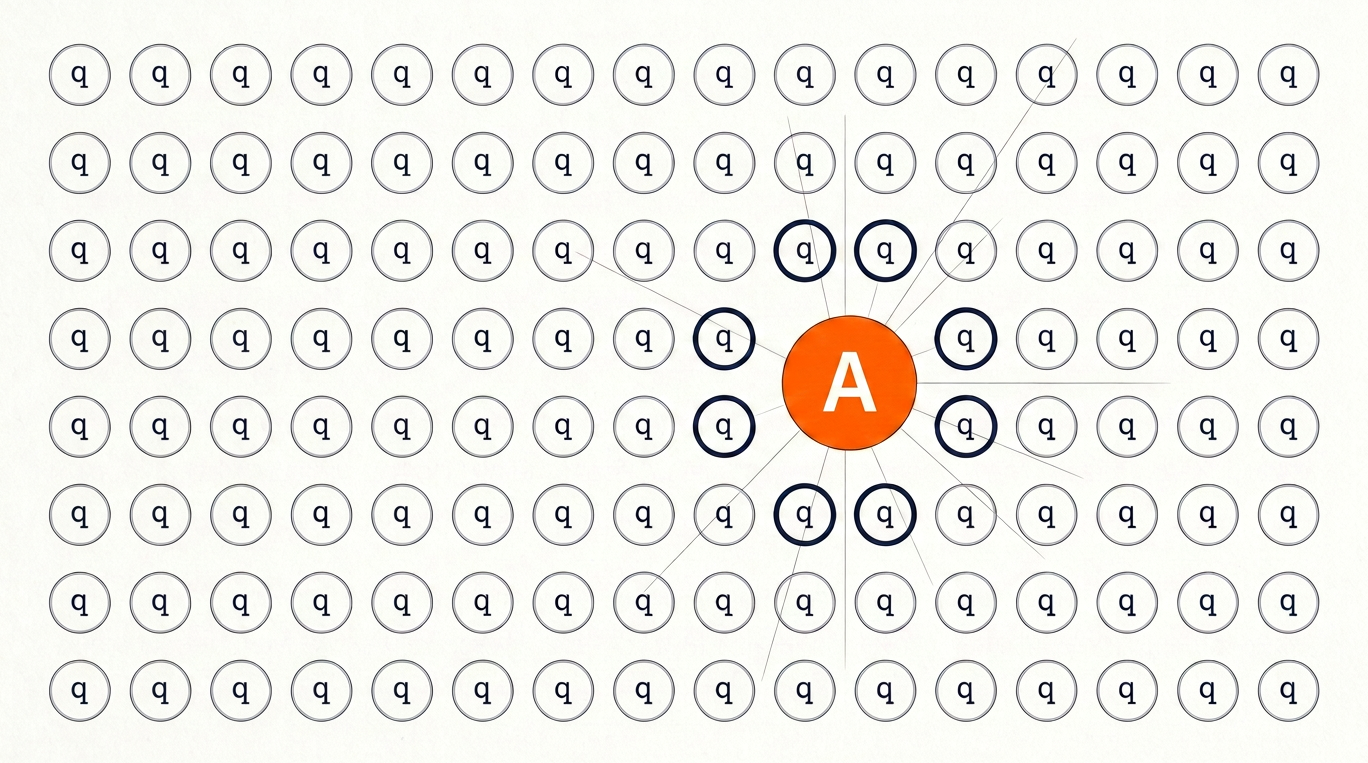
What Is Answer Engine Optimization? Optimize to Be the Answer, Not the Question
The short answer
Answer Engine Optimization is the practice of creating content that answers what people actually want to know, so that AI systems select your business when they assemble a response.
The distinction that matters is this: AEO is not optimizing for questions. It is optimizing to be the answer. Those sound similar and they produce completely different work.
Every definition of AEO you will find says roughly the same thing — structure your content so AI systems can extract and cite it. That definition is not wrong, but it is skin-deep, and following it leads people straight into building content for machines.
Which is the mistake Google spent twenty years trying to get people to fix. Search engine optimization has been clear on this from the beginning. One of the most important aspects of SEO is creating content for people, not for search engines. AEO is no different. Being the answer for a person is the real key to AEO success.
AEO is about becoming the answer, not necessarily answering questions
Optimizing for questions is the new version of optimizing for search engines. Think about what “optimize for questions” actually asks you to do. Find the interrogative phrases people type, then produce blocks of content shaped to match them. You are targeting the format of the query rather than the person behind it. That is engine-first work wearing a new acronym.
Optimizing to be the answer is the opposite. It starts from the assumption that the audience looking for answers is made up of real people. Whether you want to be the answer for a service or for a body of knowledge, people-first AEO begins by becoming the answer, rather than answering questions just to rank. That means content — in question form or not — that is in depth, original, and genuinely demonstrates you know the subject.
Search engines are themselves constantly being optimized to connect users with trustworthy sources. So even if you answered every question in the world, a domain that has not demonstrated real trust and authority will struggle to appear in AI Overviews or traditional search.
The parallel is this:
Optimizing for questions
- Targets the phrasing of the query
- Produces short blocks shaped for extraction
- Assumes the system matches strings
- Only captures the question forms you guessed
- Engine-first work with a new label
Optimizing to be the answer
- Targets what the person needs to know
- Produces content deep enough to prove expertise
- Assumes the system understands meaning
- Captures question forms nobody anticipated
- People-first work, which is what Google asks for
The clearest evidence that optimizing to be the answer is more effective than optimizing for questions is the screenshot further down this page. A person typed what they needed in plain language, and AI Overviews found the brand we worked on anyway — because we had genuinely covered the subject, not because it matched a phrase.
Answer questions with depth and genuine expertise
It is worth being accurate about the numbers here, because the industry is not. A common claim is that most searches are questions. They are not. Backlinko’s research puts question-phrased queries at roughly 14% of all searches, and other studies put it closer to 8%.
Two figures matter far more.
The first is the trend. Question-based searches have grown from around 8% in 2023 to roughly 21% in 2026 — a jump of more than 160% in three years.
The second is intent. Roughly 80% of all search queries are informational, meaning the person wants to understand something rather than buy something immediately. Whether they phrase it as a question is a formatting detail. What they want is an answer.
And then there is the interface itself. AI assistants are chat-based. Asking is the natural way to interact with them, because that is what the interface invites. You do not type keywords into a conversation. Every response an AI produces is an answer to something, which means the only thing being judged is whether your content answers well.
None of this means you should ignore the questions people ask. Finding them is genuinely useful, and there are good tools that surface them. The point is what you do next. An answer written to satisfy a search engine is a few sentences that technically address the query. An answer written to satisfy a person is fleshed out, specific, and worth reading — what Google calls helpful content. Both will contain the question. Only one of them is worth citing.
AEO is not an FAQ section
This is the most common failure, and it is worth naming plainly. An FAQ is a lazy way of answering questions. It takes questions that each deserve real treatment and compresses them into three-sentence entries, then treats the resulting list as an AEO strategy.
If a question genuinely matters to your audience, it deserves its own in-depth answer, not a row in an accordion. That is what proves expertise. A short answer proves that you know the answer exists.
Google has now made this argument for us structurally. FAQ rich results were deprecated in May 2026 — the expandable question-and-answer snippets no longer appear in search results at all. Existing FAQ markup causes no harm, but it produces nothing visible. The format that everyone treated as the shortcut to answer visibility now returns nothing.
The useful reframe: AEO is the understanding that your audience has real questions about what you offer, and that answering them thoroughly is what establishes authority. Depth is the mechanism. Google describes the same thing as experience, expertise, authoritativeness, and trustworthiness, and it affects both traditional rankings and AI citations, because both are drawing on the same underlying assessment of whether you know what you are talking about.
AEO case studies
Two examples, both captured directly from Google AI Overviews.
Citations for answers happen as a result of quality content, regardless of question targeting
Olga Buzdalova is a Calgary artist working under the name HelgaWildArt. The objective was gallery exhibitions for a specific body of astral and cosmic themed work. The page built for her explains who she is, what she makes, and what she is working toward. It was written as an account of an artist, not assembled around keywords.
The page does not contain the question below. It was never structured around it. There is no matching heading, no answer block written to satisfy it, and no attempt to anticipate that anyone would phrase a search that way.
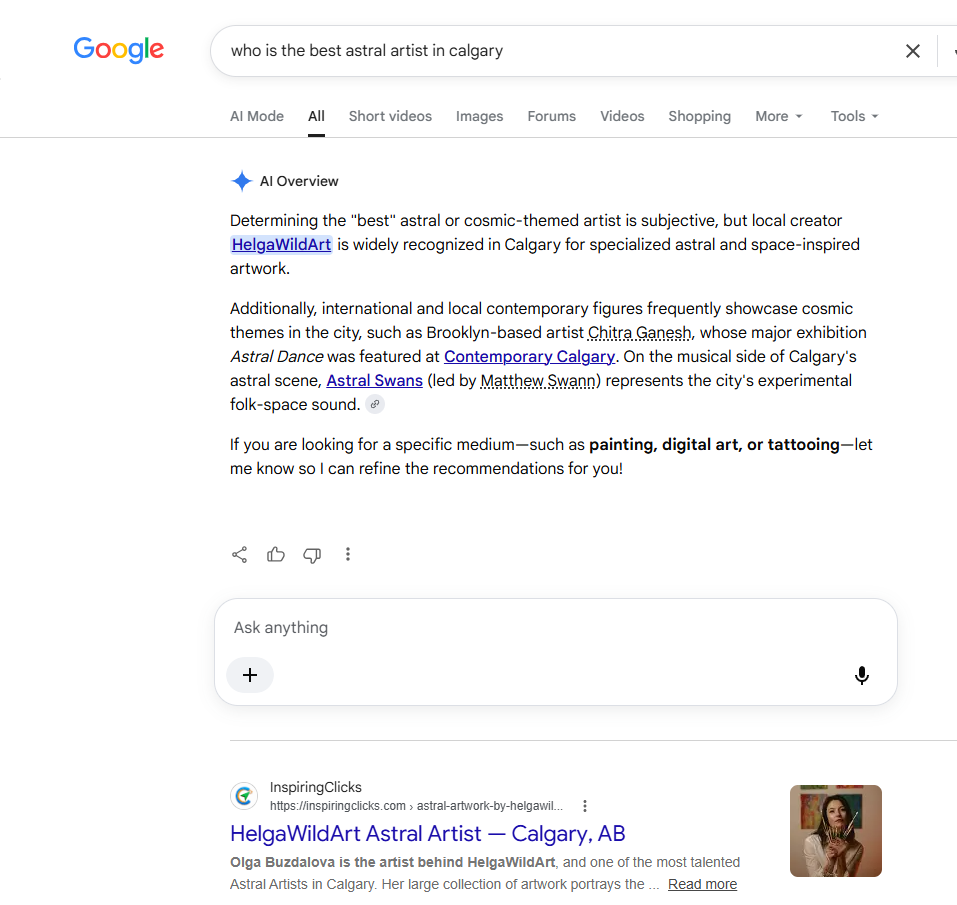
The page was cited for a question it never answered in the form the question was asked. Under a model where AEO consists of matching question strings to answer blocks, that outcome would not be possible, because no matching string exists on the page.
What the result demonstrates is that the system assessed meaning rather than phrasing. It sought a credible source covering the subject, and a source that covers a subject thoroughly can become the answer without having targeted the question at all.
Search engines learn by association, leading to citations across various different phrases
The second result comes from the same page and demonstrates the other half of the same principle.
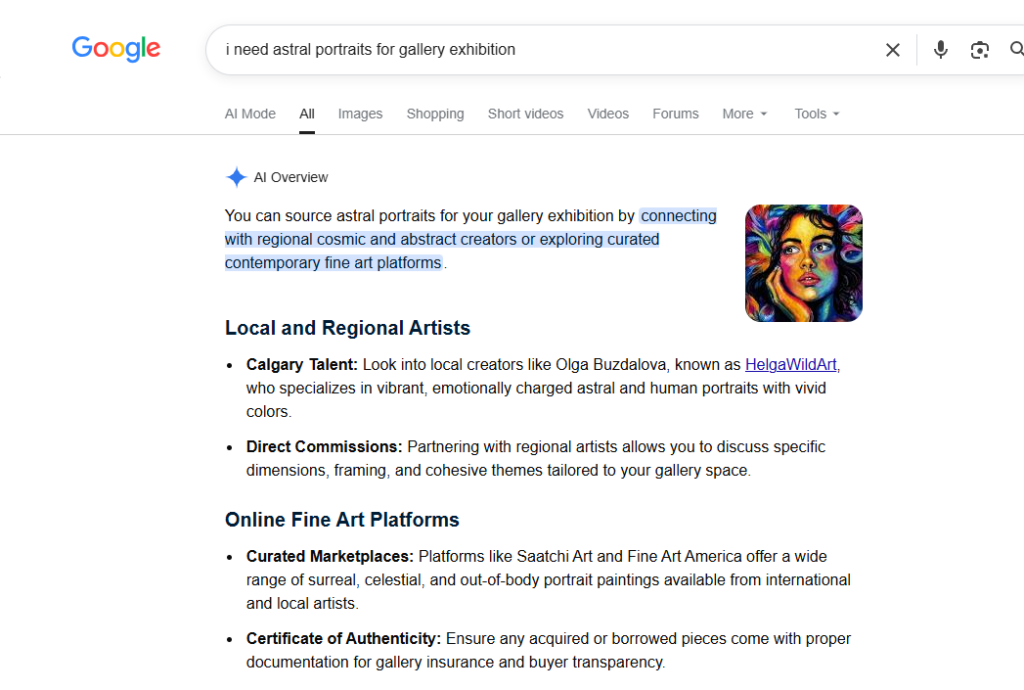
Consider what the query omits. It is not phrased as a question. It does not name Calgary. It does not use the word artist. It does not identify her. It is a person stating a need in the way people ordinarily speak.
One comprehensive page satisfied both a question query and a non question query without having been built for either. Search engines associate related concepts, and a page that covers its subject properly accumulates those associations on its own. The result is visibility across phrasings the page never targeted.
This is why AEO cannot be separated from SEO. It stems from it. The qualities that make a page worth ranking are the same qualities that make it worth citing, and a business that abandons traditional SEO in pursuit of AI visibility is likely to lose both.
What Google says does not work for AEO
On May 15, 2026, Google published its AI optimization guide, including a section addressing tactics circulating under the AEO and GEO labels. It named several specifically.
Scroll to see all columns
| Tactic | Google’s position |
|---|---|
| llms.txt files and other AI-specific markup | Not used as a visibility or ranking input |
| Content chunking | Unnecessary. AI systems synthesize across pages |
| AI-specific schema | No special markup required for AI Overviews or AI Mode |
| AI rewriting of existing content | Named as ineffective |
| Inauthentic mentions | Named as ineffective |
| FAQ rich results | Deprecated May 7, 2026. Existing markup is harmless but produces nothing visible |
One important limit applies to that table. Google’s guidance is about Google: Search, AI Overviews, and AI Mode. It is not a statement about ChatGPT, Claude, or Perplexity, which are separate systems that nobody outside those companies can speak for. Anyone presenting Google’s mythbusting as a universal verdict is overreaching.
We tested llms.txt ourselves
Roughly five months ago we built an llms.txt file for inspiringclicks.com and watched what happened. Nothing did. No increase in citations, no new referral pattern, nothing attributable to the file.
To be honest about the limits of that: we did not run a controlled test, so we cannot tell you it definitively does nothing. What we can tell you is that our experience and Google’s published guidance point in the same direction, and so does the independent data.
There is also a complication worth sitting with, which we only discovered later. During that entire window, our own firewall was challenging AI crawlers before they ever reached the site. The file may never have been read at all. More on that below.
Why you should never use “hacks” for Answer Engine Optimization
Start with what the word means. Calling someone a hack means they are a fraud. A hack, as a technique, is a shortcut. Neither meaning belongs anywhere near a strategy you are paying for.
Any promise of an AEO hack fails in one of two ways. Either it does not work, and you were sold something because you were anxious about being left behind. Or it does work briefly, which is worse, because a shortcut works by cutting out the things that produce durable results — consistent quality content, genuine authority, relevant links earned rather than bought. You end up with a position built on nothing, and it goes away.
SEO is a process. AEO is part of that process, not a replacement for it. And the process is the same one it has always been: authentic, people-first content, executed with strategy.
The thing almost nobody checks first
Before any of this matters, one question has to be answered: can the AI systems actually reach your site?
Ours could not. Our security firewall was scoring datacenter IP addresses as suspicious and serving them a JavaScript challenge instead of the page. Real browsers pass that challenge automatically. Crawlers cannot. So GPTBot, ClaudeBot, PerplexityBot, and OAI-SearchBot were being turned away at the door, and we had no idea until we went looking.
This is the failure mode nobody writes about. People implement AEO tactics on sites that AI crawlers cannot read, see no results, and conclude the tactics failed. The tactics were never tested. The crawler never arrived.
Crawler accessibility is a technical problem with real depth to it — different crawlers, different purposes, published IP ranges, firewall allowlists that go stale. We cover it properly in our article on generative engine optimization. For now, the takeaway is simply this: check that the door is open before you rearrange the furniture.
How to test whether your answers are actually being cited on AI Overviews
If you are going to check your own AI visibility, do it in a way that produces a result you can trust.
- Log out completely, and use a private or incognito window. Personalization and chat memory will show you results a stranger will never see.
- Use a device and network you have not used to research the same topic, if you can. Your own history is the largest source of false positives.
- Ask the question the way a customer would phrase it, not the way you would. “I need astral portraits for a gallery exhibition” is a real query. “Best astral artist Calgary AB” is a keyword.
- Test across systems. Google AI Overviews, AI Mode, ChatGPT, and Perplexity all retrieve differently, and a citation in one says little about the others.
- Take a screenshot with the date. AI answers are not stable, and a result you cannot document is a result you cannot report.
If you skip the first two steps, you will find yourself everywhere, and none of it will be real.
Tools that track AI citations, and what to know before you buy one
Manual testing is free, immediate, and shows you exactly what a customer sees, which is why it is where we start and what we have used for the results on this page. Measuring change over time across dozens of queries and multiple engines is a different job, and that is what the paid tools are for. Here is how the landscape breaks down.
Three names consistently anchor the category:
- Profound: The enterprise standard, starting around $499 USD/mo (~$680 CAD), built for large-scale source-level citation data and prompt tracking.
- Peec AI: A mid-market platform priced from €89 to €199 EUR/mo (~$98–$218 USD / ~$135–$295 CAD), delivering the core analytics and visibility tracking most mid-sized businesses need.
- Otterly.AI: An entry-level option starting at $29 USD/mo (~$40 CAD) for basic brand and citation monitoring.
Legacy platforms like Semrush and Ahrefs have also added AI visibility modules to their existing suites, which may be all you need if you already hold an active subscription.
Three things to know before spending anything
1. Watch for vendor bias. Almost every comparison guide in this space is written by a software company ranking its own tool first. Read them accordingly.
2. Distinguish AI search tracking from LLM probing. AI search monitoring tracks what live users see in tools like Google AI Overviews or ChatGPT, including real links and citations. LLM training probing tests a static model’s memory and returns no live web links. Most businesses need search monitoring.
3. Pricing changes rapidly. Category pricing and features shift on a weekly basis. Always verify current tiers directly on a vendor’s pricing page before committing — including the figures above.
Start with the free tool you already own: Google Search Console includes AI Overview impressions directly in its performance reporting. It will not reveal what the overview said about you, but it costs nothing and gives you baseline impression data out of the box.
What actually earns the citation
Across everything above, the pattern is the same. The pages that got selected were not built for extraction. They were built to genuinely cover their subject, published on a site that could be crawled, by a business that could be verified as real.
Which means AEO has, in a way, forced the industry to do SEO properly. It entails fulfilling the inquiries people have, which in its nature is being helpful, thereby fulfilling the requirement of helpful content. It is why the term “helpful content” exists in Google’s documentation, and why the updates carrying that name are aimed at removing everything that is not.
AEO is not a new discipline that replaces SEO. It is the same requirement, only extended, and crawled by search engines that look for the best sources of user fulfilment.
Want to know whether AI is citing your business?
We run AEO and search campaigns for businesses that want to be found — the strategy, the writing, and the technical work, done by the person you actually talk to.
A strategy call is a quick, no-pressure conversation. Discuss your marketing with a specialist, ask your questions, and get clear next steps.
If you would rather write than call, the request form takes about thirty seconds and we reply within one business day.