




Thought Leadership SEO: The Strategy Behind Ranking as the Authority
AI has lowered the barrier of entry to publishing and filled the internet with content that repeats what already exists, so much so that some believe search engines have become answer engines. Search has changed, and yet many continue doing search engine optimization the same way. In an age of infinite thought, the quality of an idea, and the experience behind that idea, is what turns mediocre marketing into market leadership. If what worked before is not working now, then perhaps a new approach is needed. This is what this article is about: changing how you think about SEO, and providing data-backed tips for doing it differently.
Thought leadership SEO is the responsibility taken by the lead SEO to develop an undeniable narrative that establishes a brand as the authority in its industry, using creative content, clean technical foundations, and genuine social proof.
The term is literal. Thought leadership means leading thoughts, and a thought is led by a person. That is why the emphasis falls on the person directing the strategy rather than on the volume of pages produced.
Most explanations of thought leadership SEO are lists of deliverables: keyword planning, audience research, content hubs, a monthly page count. Those things are real and this article covers them in detail further down, because a checklist is useful once you know what you are building toward.
What a list cannot tell you is why the same deliverables produce a market leader for one business and a folder of unread blog posts for another. That difference is the subject of this article: who leads the strategy, what makes it unique, when it starts, and how it is executed page by page.
What is thought leadership SEO?
Thought leadership SEO is a consolidated SEO strategy that establishes a brand as the leader in a particular section of the market. That section can be an industry, a service, a niche, a core competency, a product, or even an idea.
Three things have to be present at once, and the absence of any one of them is what turns an SEO campaign into ordinary content marketing.
- Creative content that expresses, or supports other content that expresses, a perspective, or solution, nobody else in the market has.
- Clean technical foundations so that search engines and AI systems can reach, read, and share that perspective to users.
- Verifiable proof of concept like reviews, case studies, and citations that is effectively used throughout the SEO campaign.
Creative content expresses core offerings and original insights based on real experiences, which search engines then cross reference against what is found elsewhere on the internet (social proof). The feedback mechanism created between content, readability, and real experiences is the foundation of thought leadership SEO, and the three together form a consolidated SEO strategy. The SEO timeline, meaning how long it takes a company to rank, depends on all of these factors.
Why SEO campaigns need a leader
The strategic decisions that direct an SEO campaign require judgment, and judgment is exercised by a person. Before a keyword is selected or a page is written, it is important that someone determines what the brand stands for, which ideas it hopes to satisfy or change, and which assumptions currently held by competitors it intends to do better than. Those determinations require knowledge of the business, its market, its competitors, and the beliefs the owner holds about their own field, and that combination of knowledge can be tapped into only by a person who has an invested interest in the business.
In other words, a successful SEO campaign needs someone who cares.
This is where automation reaches the edge of what it can contribute. AI is genuinely useful for researching faster, structuring information, and checking work quickly. It cannot develop a winning SEO campaign on its own, because a winning campaign requires thinking past what the industry already accepts, and that means doing the work, reading the data, and recognising the difference between what is widely repeated and what actually moves rankings.
What it comes down to is context and experience. Both are human qualities, and their necessity is what makes thought leadership SEO a human-led discipline rather than an automated one. The practical consequence is a deliberate trade in volume: a campaign publishing fewer pages behind a defined strategy will outperform a campaign publishing a high volume of pages with little direction behind them.

Did you know?
Google added Experience to its search quality rater guidelines in December 2022, turning E-A-T into E-E-A-T. Experience measures whether the person who produced the content has first-hand involvement with the subject: whether they used the product, visited the place, or performed the work being described.
That update arrived within weeks of ChatGPT reaching the public. Of the four criteria, Experience is the only one a language model cannot produce, because it requires having done the thing rather than having read about it. Whatever prompted the change, the direction it points is clear, and it is the principle this discipline is built on.
Thought leadership SEO is unique and original
Leading brands are often original, so the strategy behind thought leadership SEO is to create unique narratives through content that search engines then reference to potential customers.
Experience is the newest addition to E-E-A-T, the framework Google’s quality raters use to judge whether content deserves to rank. Experience is a fundamentally human quality, and no two people accumulate it in the same way. Businesses inherit that same quality, because a business is built out of the experiences of the people running it. An SEO strategy that accounts for those specific experiences, rather than working around them with material any competitor could publish, is what makes it thought leadership SEO.
This is also where the mechanics of ranking are commonly misunderstood. No site outranks another because of a single factor. One change moves the needle for one brand and does nothing for another, and the work is to find what is missing or what has not been done, and then do it. Blogging is the clearest example: four articles a month can transform one company’s visibility but do nothing at all for another.
The reason is that blog posts do not cause rankings. Blog posts that are properly integrated with every other part of the website and the brand do.
How does thought leadership SEO relate to traditional SEO?
Thought leadership SEO does not conflict with traditional SEO. There is a common misconception that SEO exists to answer questions and capture demand that already exists, and that thought leadership, which challenges assumptions and offers new ideas, is therefore unnecessary because it would require creating a new market.
Thought leadership SEO is not working against what already exists. It is offering what already exists in better fashion, by bringing an original position to demand that is already there. Someone searching how long SEO takes is asking a question that thousands of pages already answer badly, and answering it in a unique way backed by experience is thought leadership performed on a high-volume keyword.
The question to ask is what you do better than your competitors, and why. Keep the answer in mind throughout an SEO campaign so that the narrative is expressed clearly across the content, and pair it with the technical foundations that let search engines reach that content in the first place and share it with the people searching.
Who leads the thought, the strategist or the business?
Both, and the split is precise. The business supplies the expertise. Whoever leads the SEO develops, implements, and refines the strategy that turns that expertise into E-E-A-T signals a search engine can read and act on. Those can be the same person, and often are when a business owner runs their own SEO.
Anyone running a business knows things about their trade that nobody outside it knows. That knowledge is the raw material, and on its own it does not rank, because search engines cannot see what is in someone’s head or what gets said on the phone to customers every day.
The work is to put that knowledge to use, and it happens in four stages.
- Gather the external proof. Reviews, real local signals, and anything else that corroborates the expertise from outside the website.
- Optimize it for genuine search intent. Map the knowledge to the keywords people actually use when they have the problem the business solves.
- Publish it against a content strategy. Individual pages accumulate authority only when they are structured to support each other.
- Attribute it to a real person. Authorship is a ranking signal, and it has to be verifiable.
That last point works differently depending on the page. A blog post needs an author bio box identifying who wrote it and why they are qualified to. A landing page needs the business owner or the person behind the work to be visibly present, because that is what makes the expertise attributable rather than anonymous.
This is why thought leadership SEO cannot be bought as a template. Every business holds a different set of knowledge, so the strategy built around it has to be built for that business specifically.
What does a thought leadership SEO campaign consist of?
Five components make up the campaign, and each one is a discipline rather than a task. Below is what each one is, followed by one concrete instruction for doing it.
-
Strategic keyword planning
Keyword planning is the process of deciding which searches the brand will compete for, in what order, and how those pages relate to each other. It is a plan for a market position, not a spreadsheet of search volumes.
How to do it: rank your keyword list by commercial value first and search volume second, then group the list into hubs. Every keyword should belong to a parent topic you intend to own, and anything that fits no hub is either a new hub or should be dropped.
-
Audience research
Audience research means learning what the people you are trying to reach are actually worried about, how they make decisions, and what they have already been told by competitors.
How to do it: read your own customer reviews and your competitors’ reviews before writing anything. Reviews contain the exact words customers use for their problems, along with the complaints that reveal what the market is failing to deliver.
-
Hub and spoke content structure
A hub is a comprehensive page targeting the main commercial term. Spokes are supporting pages covering specific sub-questions, each linking back to the hub. The structure concentrates authority on the page that needs to rank while capturing informational searches around it.
How to do it: make the hub the page you want to be found for when someone is ready to buy, and give every spoke a link pointing up to it. Keep the URL structure shallow so the relationship is visible in the address itself.
-
Consistent publishing of high-quality pages
Quality and quantity both have to be present. A small number of excellent pages outperforms a large number of thin ones, and a single excellent page published once outperforms nothing at all only briefly.
How to do it: before publishing, check whether the page contains at least one thing a reader cannot find on the first page of results for that keyword. If it does not, it is not finished.
-
Generative engine optimization built in
Generative engine optimization is the work of making sure AI systems can reach your website, read it, and correctly identify what it says about your business. It belongs in the strategy from the start rather than being added later.
How to do it: ask ChatGPT and Perplexity what your business does, logged out and in a private window. If the description comes from directories and other people’s mentions rather than your own site, start with access rather than content. The InspiringClicks article on generative engine optimization covers how to check and fix it.
Why GEO and AEO belong inside thought leadership SEO
AI search expands the opportunity for original perspectives rather than limiting it, which makes it a natural fit for this approach. Answer engine optimization is the practice of providing answers and solutions to what users ask. Questions are endless, answers are endless, and so the space for original solutions is enormous.
The size of the internet is what makes this matter, and AI is compounding that size. More content means more noise, and more noise means two things happen at once.
- Original strategy becomes harder to execute, because there is more to be different from.
- Leaders become more valuable, because people navigating noise look for someone to trust.
A larger internet produces more inquiries, and more inquiries produce more opportunities. The brands positioned to capture them are the ones whose answers are distinctive enough to be selected out of everything else available.
When does thought leadership SEO start in a campaign?
SEO that uses thought leadership strategies begins from the brand narrative, before a single keyword is chosen or a page is built. A brand narrative is the account of what the business does, who it does it for, and what it does better than any other competitor. This understanding is what allows the thoughts and ideas worth leading with to be identified, so that they can permeate the entire SEO implementation, and so that as rankings increase the brand becomes the recognized leader of those ideas.
What order should the work happen in?
Publishing begins as soon as there are pages worth indexing, and the pace increases once indexation is confirmed. These stages overlap rather than running in strict sequence, because crawlability cannot be verified without publishing pages and watching what happens to them.
-
Clear the obvious technical blockers first
Check robots.txt, confirm a sitemap exists and is submitted, and make sure content sits in the HTML rather than being assembled by script. These are checkable before anything is published and they are the failures that waste the most time when missed.
-
Publish, then verify indexation
Indexed pages are the first measurable signal in any campaign, and they are also the test of whether the technical work held. Watch the Pages report in Google Search Console as the first pages go live, and use the URL Inspection tool to check any individual page and see exactly why it has or has not been indexed. Pages that stay unindexed point to a problem worth solving before publishing more.
-
Check what AI can see, separately
Indexation in Google says nothing about whether AI systems can reach the same pages, because they are different crawlers operating under different rules. Ask ChatGPT and Perplexity about the business once pages are live and see whether the answers reflect the site.
-
Increase the pace once the foundation is confirmed
Publishing consistently is worth committing to when pages reliably index and get read. Doing it before that commits months of work to a channel that has not been shown to function.
The third step is the one InspiringClicks learned the hard way on its own website. For three months the pages were indexed, ranking, and completely unreadable to AI systems, because a firewall was quietly turning their crawlers away. Google was unaffected the entire time and nothing in any standard reporting tool showed a problem. The full account is documented in the InspiringClicks article on generative engine optimization, linked earlier in this piece.
Thought leadership SEO is a process that requires data to verify what is working and what is not. Content, technical audits, and social proof all flow under its central purpose, which is to establish the brand as the authority its market turns to first.
Who is thought leadership SEO right for?
Every business that wants to grow, though the balance of the work shifts with the situation. A company already leading its market needs less technical remediation and more consistent publishing, because relevance has to be maintained rather than established. A business losing ground to competitors in search usually needs both.
The largest corporations in the world continue to advertise despite universal name recognition. They do it because marketing grows businesses, and growth does not stop being valuable once a name is known.
The businesses this suits least are those not seeking growth, already operating at capacity, where additional leads hold little value. Even then the objective can shift rather than disappear. Thought leadership SEO can be used to develop an existing narrative, tell the story across inner pages, or present case studies, with the aim of strengthening trust among existing customers rather than increasing rankings.
What does a specific business actually need?
That depends on which trust signals already exist, and the answer varies more than the industry usually admits.
Content strategy is an important part of SEO, but there is no fixed number of posts per month that guarantees ranking for high-intent keywords. It is true that blogs can rank on their own for long-tail keywords; however, when it comes to ranking for high-intent keywords like specific products or services, the idea of a content strategy is to support the pages that target them.
Some websites can rank without a comprehensive content strategy, and those are typically businesses with heavy trust signals beyond their website, such as a large volume of Google reviews. Other websites need a more comprehensive strategy precisely because they lack those signals. How to approach an SEO campaign that employs thought leadership depends on which of those two situations applies.
Scroll to see all columns
| What the situation looks like | What it usually indicates |
|---|---|
| Strong reputation offline, little visibility in search | Existing authority is not represented on the website yet |
| Competitors rank higher despite a weaker website | Their brand is better known, so their name is searched more often |
| Publishing regularly with no change in results | Content is not integrated with the rest of the site or the brand |
| Ranking on Google but absent from AI answers | AI bots are not accessing the website |
How do you approach a thought leadership SEO campaign?
Start with the brand story, not a content calendar. Before building a keyword list, establish what the business offers, what story it wants to tell, and what its narrative actually is. That story sets the basis for everything downstream, because it humanizes the business, and a humanized business is far easier to write content for that other people respond to.
The sequence then matters. Once the narrative is established, identify the search intent behind it and map that intent to the pages that will convert it into customers. Originality and uniqueness are what put people-first content on the page, and people-first content is what Google’s guidelines are explicitly written to reward.
Every InspiringClicks campaign begins this way, which is why no two of them look alike even when the industries overlap.
Focus on quality content and reviews over generic citations
Citations have their place when they are used to show that a business entity is legitimate. This matters most for startups that do not yet have strong operational signals such as a Google Business Profile or a body of reviews.
Citation packages are widely available from third parties such as BrightLocal. They do produce consistent name, address, and phone details across the internet. What they generally do not produce is relevance to the industry, and many of the listings are not indexed by Google at all. InspiringClicks ran a citation package and found that only two of the thirty provided resulted in do-follow backlinks to the website.
Citations do not move the needle for rankings nearly as much as quality content and reviews from real customers.
Get cited in AI Overviews
Publish content that is both specific and in-depth. AI systems cite sources that demonstrate expertise and cover a subject with real detail, which means generic coverage of a popular topic through a short FAQ carries far less weight than comprehensive coverage of a single question or topic.
Beyond AI Overviews are citations from ChatGPT, Perplexity, Claude, and other generative search tools. Once a topic is fully fleshed out, what matters is whether those bots can access the content in the first place, which makes confirming that the website is crawlable by AI crawlers as important as the writing itself.
Prove expertise in your industry by providing value to it
Give your industry something valuable that it can use. Expertise demonstrated through something genuinely useful to other people working in the field is far more helpful for SEO than expertise stated on an about page. It can be a tool, original research, a documented process, a template, or a public breakdown of a problem and its solution using first-party data.
InspiringClicks built tools that SEO professionals use worldwide, and each one came directly out of client work rather than a content plan.
- Google rank checker returns a website’s real position for any keyword in any city, without a VPN. The most accurate way to see where a page ranks is to query Google directly, which is exactly what the tool does.
- Heading analyzer lists every heading on a page in order of appearance and flags structural problems. It was built after a technical audit surfaced duplicate H1 tags generated by a website theme, which is a genuine ranking problem and one that is easy to miss.
- On-page SEO analyzer checks the elements that determine how a page is understood, including title tags, meta descriptions, headings, and content structure, and reports what needs attention.
All three are free. The work produced the insight, and the insight produced something worth giving away.
First-hand results from applying thought leadership SEO
A website that started from scratch in the middle of the AI boom is a useful example of thought leadership SEO at work. Leading with new ideas matters more now than it ever has, because most ideas online are simply repeated, in much the same way that AI generates content by restating what already exists elsewhere. InspiringClicks began its SEO campaign less than twelve months ago and now records 1.17 million Google impressions.
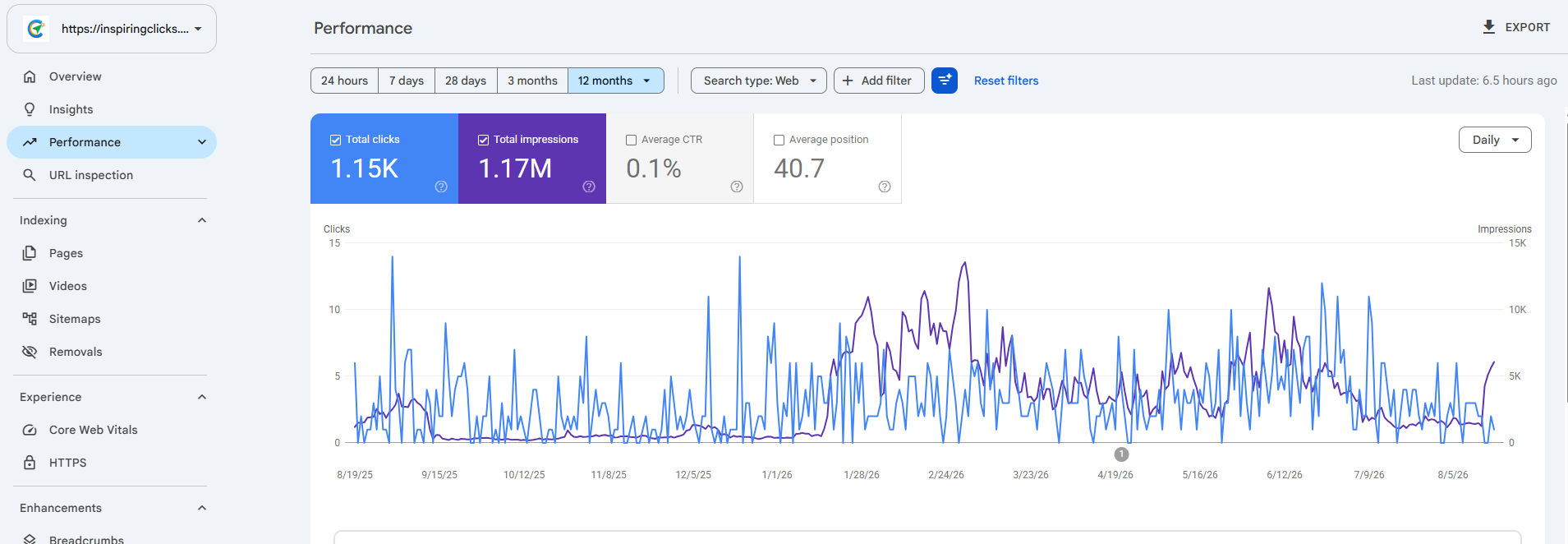
It is important to understand that these are impressions from Google alone. They do not account for direct visits, or for visibility on any other search engine. In reality, the brand awareness built through this work produced engagement well beyond Google, through AI Overviews, citations in generative search tools, and branded searches where people type the company name directly.
Analytics data covering the site as a whole shows the same trend from a different angle. While Google Search Console reports search data directly from Google, GA4 includes data from every source that sends people to the website: organic search across all engines, AI tools and chatbots, referrals from other websites, social platforms, and visitors who arrive by typing the address directly.
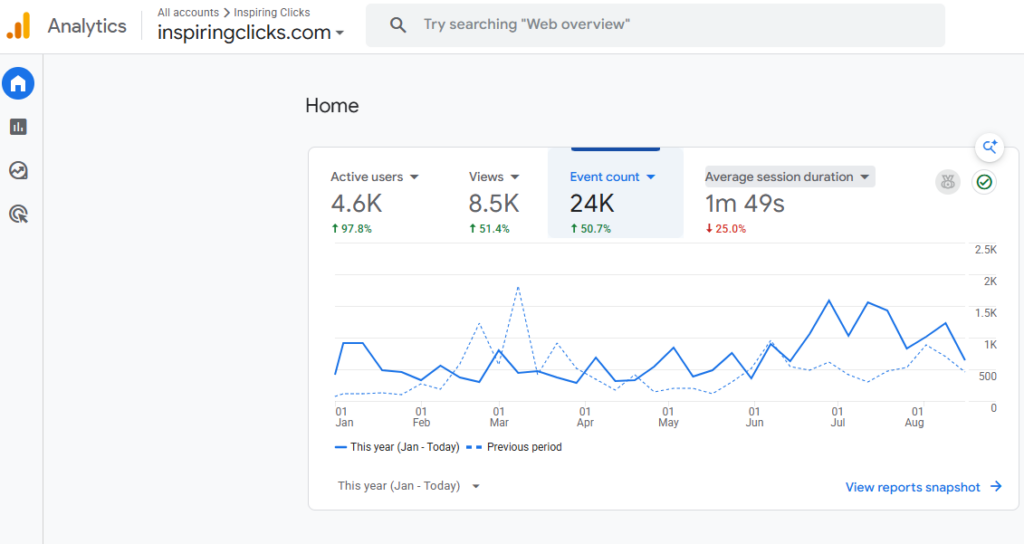
Active users nearly doubled from January 2026, which shows that search engine optimization with strong unique content angles and sound technical foundations does not confine online visibility to a single channel. Higher Google rankings equal more hits from direct search, more citations in AI answers, and more brand awareness overall.
That is what thought leadership SEO is about, and it begins with a unique perspective about your brand: what makes it different.
Want thought leadership SEO in action?
InspiringClicks SEO services are built on the approach described in this article: a strategy developed for your business specifically, technical foundations checked before anything is published, and content written by people rather than generated. You can see what each campaign includes and what it costs.
Behind them are people who genuinely care about creating a unique narrative that differentiates you in a competitive space. Request a strategy call to speak with an SEO lead specialist.