

First 2 weeksIncrease in organic pages
More pages get found
We implement fixes and publish useful content. Google crawls and indexes those pages, increasing the number of pages from your website that can be found in search.
Welcome to InspiringClicks
Get the SEO help you need when you need it. Get Found on Google search and AI overviews. Hire InspiringClicks and build your brand awareness with thought-leadership SEO that goes beyond the ordinary.

The Complete Calgary SEO Guide
SEO gets complicated when every tactic is taught as a separate trick. It becomes much easier when you follow the customer journey. Search engines need to find your business, understand it, find reasons to trust it, and decide when it deserves to be shown. Then your website still has to convince a person to choose you.
Search Engine Optimization is the work of improving how easily the right people can discover, understand and trust your business through organic search.
That definition is deliberately broader than “ranking a website.” A ranking is only an opportunity to be seen. A click is only an opportunity to be considered. The business result happens when the person on the other side believes you are the right choice.
Before a page can produce a customer, several things have to go right. Google has to discover it, crawl it, index it, understand what it represents, evaluate it against alternatives, and decide it deserves visibility for a particular search.
This is why SEO is not one activity, but a process. Technical SEO influences discovery by search engines, and this includes ensuring AI bots can access a website as well. On-page SEO improves Google bots’ understanding of a page. Content is the contents—what is contained in the page—and is responsible for shaping perception because it is the means through which people interact with a website. Conversion rate optimization helps lead a person from click to action, where the purpose of the interaction is for customers to transact via booking, calling, or purchasing.
Calgary has the second-highest number of small businesses per capita among major Canadian cities. A person searching for a service in Calgary will not use B.C. in their search, even if they happen to be searching from B.C. Moreover, even when they use Calgary in their search query, they are not really asking Google to find a page that mentions Calgary. They are asking Google to find a business that can credibly serve them here. What makes Calgary SEO different are the businesses that serve here. Never compromise the customer experience just to please a search engine. Optimize for people. Make it easy for search engines to understand what you offer and who it's for, without overusing keywords.
Your website, service areas, business information and content should make the Calgary relationship obvious without stuffing the city name everywhere.
Reviews, citations, local mentions, relevant links and your Google Business Profile help corroborate the business behind the website.
Traditional organic results, the Local Pack, Maps and AI-generated answers can all shape who gets discovered.
For a local business, the website and Google Business Profile should reinforce one another. The goal is not to manufacture local signals. It is to make the signals of a real Calgary business easy for search engines and customers to verify.
When most people think SEO, they think keywords. When they think keywords, they think search volume, but it is much more than that.
Keywords are evidence of demand, and how your customers communicate. We use them to understand what people need. Then we create the best page for that need.
A strong SEO strategy does not force every keyword onto one page. It builds an information architecture in which each page has a reason to exist, satisfies a distinct need, and supports the rest of the site through intentional internal relationships, known as internal linking.
On-page SEO is the process of optimizing the content and elements on an individual webpage. The goal of on-page SEO is to make the purpose of a page unmistakable to both people and search engines. Different pages have different purposes. A good page should make sense to a person while also giving search engines enough structured input to understand the topic, purpose, and relationship the page has to the rest of the website.
Useful copy that answers the searcher's actual need, supported by descriptive headings and specific evidence.
Titles, headings, URLs, images, alt text and structured data help clarify what information means.
Links show how services, supporting topics, proof and expertise relate across the site.
On-page SEO is not about placing keywords everywhere. It’s about making the purpose of a page unmistakable to people and search engines, and integrating it with the website to improve crawlability and site authority.
You should be able to see progress happening before rankings arrive if SEO is done properly. Pages lead to impressions, and impressions lead to clicks. Each one increases before the other, but to see impressions grow, pages must be found by Google in the first place. This requires technical SEO, and it involves making your website accessible to search engines, AI bots, and people.
Great content cannot perform if search engines cannot reliably access, render or index it. Technical SEO makes sure there is a clear path between your website and the systems trying to understand and rank it. It is the technical health of your website.
Crawl paths, robots directives, XML sitemaps, canonicals, redirects and indexability determine whether the right URLs are discoverable and eligible.
Mobile usability, page speed, Core Web Vitals, JavaScript rendering and clean site architecture influence whether the page works properly for people and crawlers.
Technical SEO should mostly be invisible to the customer. When it is done properly, the website simply works smoothly for them, and effectively for you: important pages load, search engines reach them, and users can go on the path from click to customer.
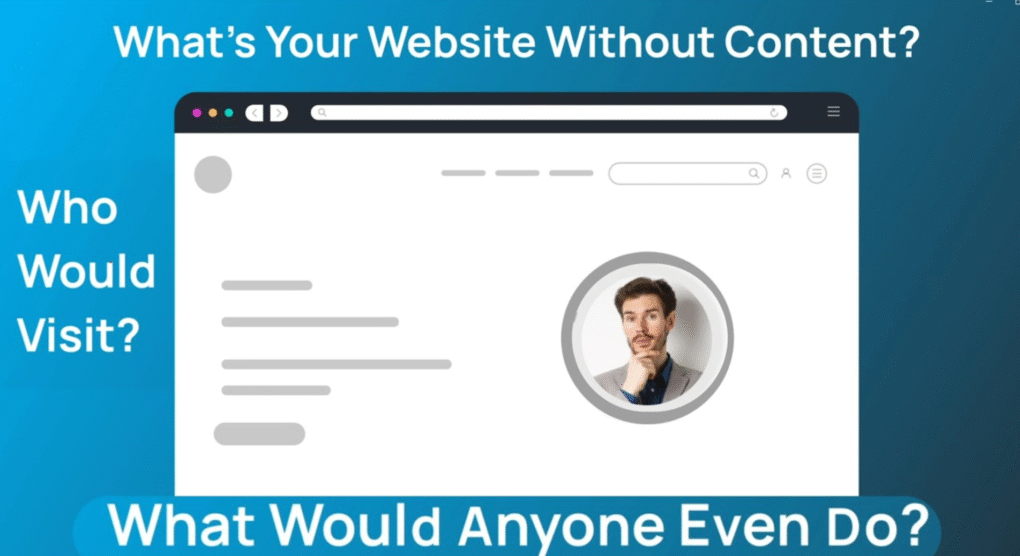
Content is the means through which everybody perceives, compares, and interacts with your business. It is the information that search engines use to connect websites with users in the first place. Without content, people would land on your website and have nothing to do. Search engines would have nothing to show in the first place.
SEO content writing works best when it draws on real customer questions, first-hand knowledge and evidence your business can stand behind. That is how human-first content becomes useful to readers, not just search engines.
View content as the thing you want to be known for. If you want to be known as the best in your industry, you must value high-quality content. AI made average information cheap. That makes genuine experience more valuable than ever; therefore, SEO content should derive from experience. Since everyone's experience is unique, this method creates unique content, thereby differentiating your business from the competition, and fulfilling what Google itself calls ‘helpful content’.
E-E-A-T—Experience, Expertise, Authoritativeness and Trustworthiness—is useful because it forces a better question than “is this optimized?” It asks whether the page demonstrates something worth trusting. Experience is particularly powerful because it cannot be created by AI. One can use AI to express it, but experience itself is fundamentally a human quality.
There is Artificial Intelligence, but no artificial experience.
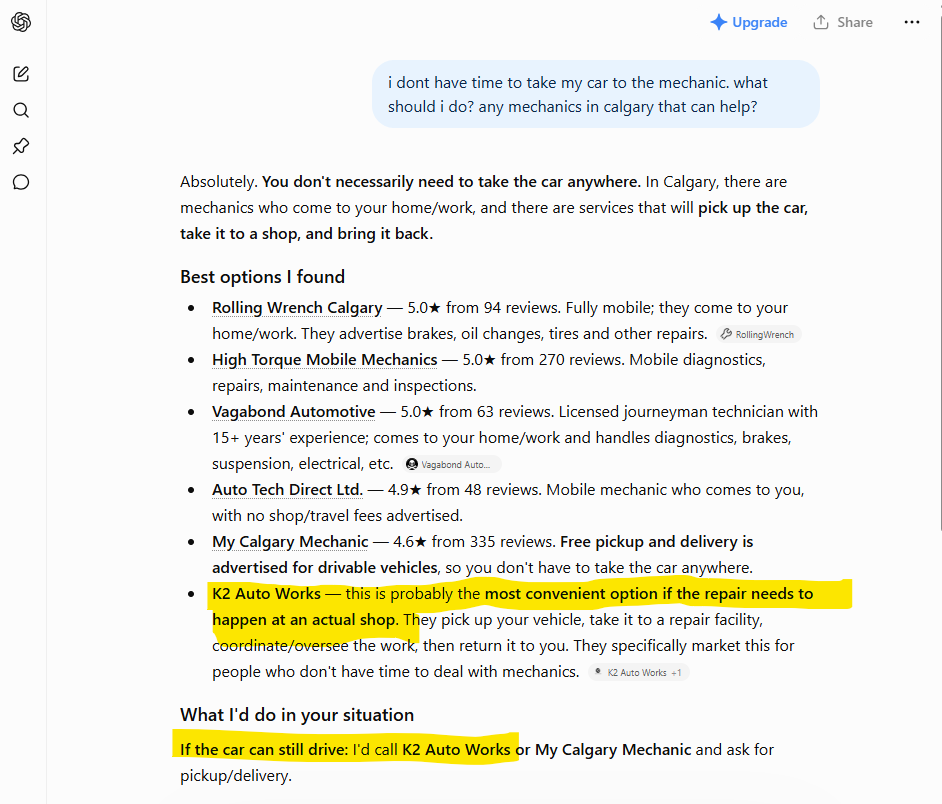
Local SEO is about helping your business appear when nearby customers search, and it has two major visibility points: your website and your Google Business Profile. A Calgary business can have a strong website and still underperform in the Local Pack, and vice versa. Google Business Profile, reviews, business data and local prominence are key to local visibility. Google primarily determines local rankings by relevance, distance and prominence.
Categories, services, page content and business information help Google match you to the query.
Proximity matters in local results. SEO cannot move a storefront, but it can remove ambiguity about the areas you genuinely serve.
Reviews, citations, links, mentions and broader reputation help establish that the business is real and recognized.
Consistency is often the foundation of local SEO. Your website should not tell one story while your Google Business Profile tells another. Name, address, phone information, service descriptions, reviews and local references should reinforce the same business identity. Only then can optimization strengthen those signals and fulfill your local SEO strategy.
Backlinks are links from other websites to yours. Quality backlinks are relevant, credible references that can reinforce the authority of your website. Buying backlinks purely for rankings is an incomplete strategy that can manufacture signals without building authority. Google can distinguish between many patterns associated with earned links and link spam, and its policies explicitly prohibit buying or selling links for ranking purposes. Agencies that sell backlinks and citations often benefit more than their clients because because the price paid for them makes no meaningful impact on SEO.
Another website links directly to a page on your site. The strongest backlinks tend to come from relevant, credible sources with a genuine reason to reference your business, work or expertise.
Your business is mentioned or listed elsewhere online, often with identifying information such as its name, address and phone number.
We recommend acquiring organic backlinks through useful content, original research, relationships, digital PR, partnerships, noteworthy work and resources that people genuinely want to reference. If backlinks are purchased for advertising or sponsorship, relevance to your industry helps ensure the placement reaches an appropriate audience, and paid links should be properly qualified rather than purchased to manipulate rankings.
Citations can be used to reinforce consistent business information across the web for local SEO. Keep in mind that changes in your business name, address or phone number mean you should also update the citations you control so outdated information does not contradict your current business identity.
Buying links purely to manipulate rankings creates a very different signal from earning a citation because a resource, project, tool or insight was genuinely worth referencing. If you decide to purchase links, ensure quality and relevance to your industry.
Google search results are now much more than blue links. They contain organic search results, sponsored ads, businesses, featured snippets, and AI Overviews.
AI is becoming part of how people search. It appears in several forms: AI Overviews and AI Mode within Google, answers from LLMs such as ChatGPT and Gemini, and dedicated answer engines such as Perplexity.
People have developed tons of acronyms to describe AI search optimization, and this makes it hard to truly understand what optimizing for AI search actually means. For this reason, InspiringClicks has developed a framework that makes this distinction clear.
Our AEO services focus on making information useful and clear enough to answer real questions, while our GEO services address how that information can be accessed and understood by generative search systems. Neither approach guarantees placement in AI Overviews or other AI-generated answers.
AEO and GEO are two sides of the same coin, but they are not identical. The difference between the two is similar to the difference between on-page SEO and technical SEO.
Answer Engine Optimization (AEO) is the content side: creating useful, authoritative content worth selecting as an answer. Generative Engine Optimization (GEO) is the technical side: making sure generative AI systems can access, read and correctly understand that content.
Clear, substantive, well-structured information makes it easier for search systems to extract and represent what you know accurately.
Technical accessibility, entity clarity, crawlability and corroboration influence whether your information can participate in AI-powered discovery.
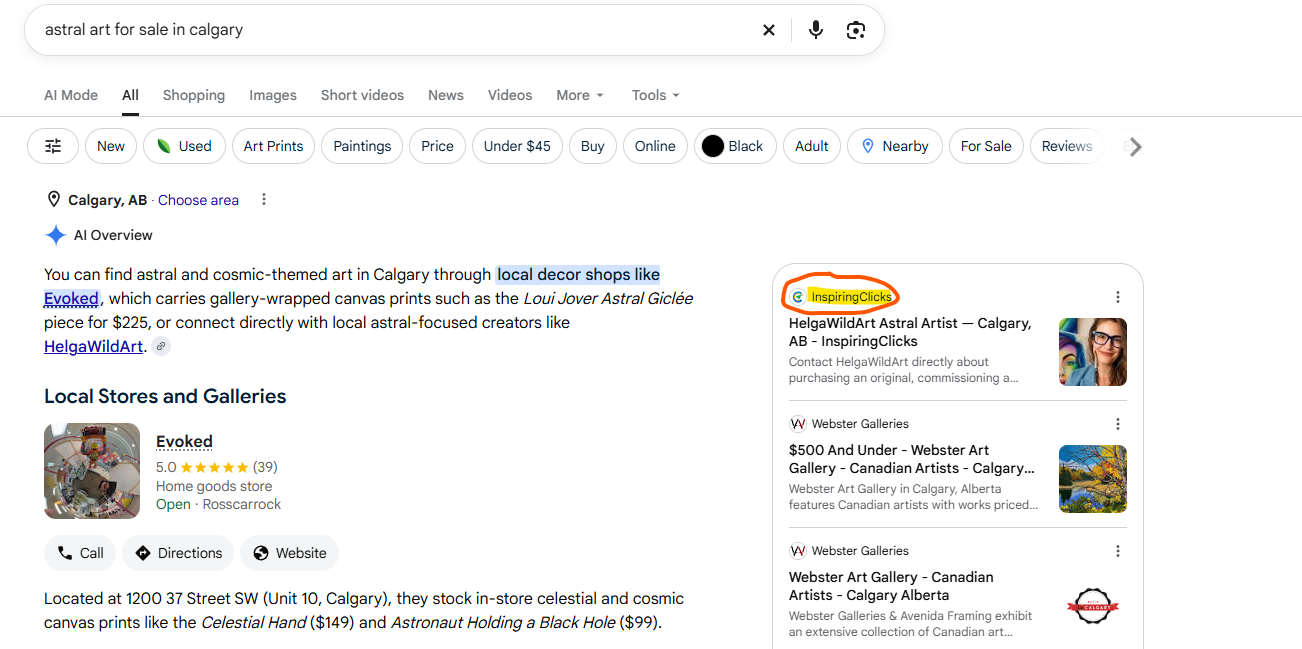
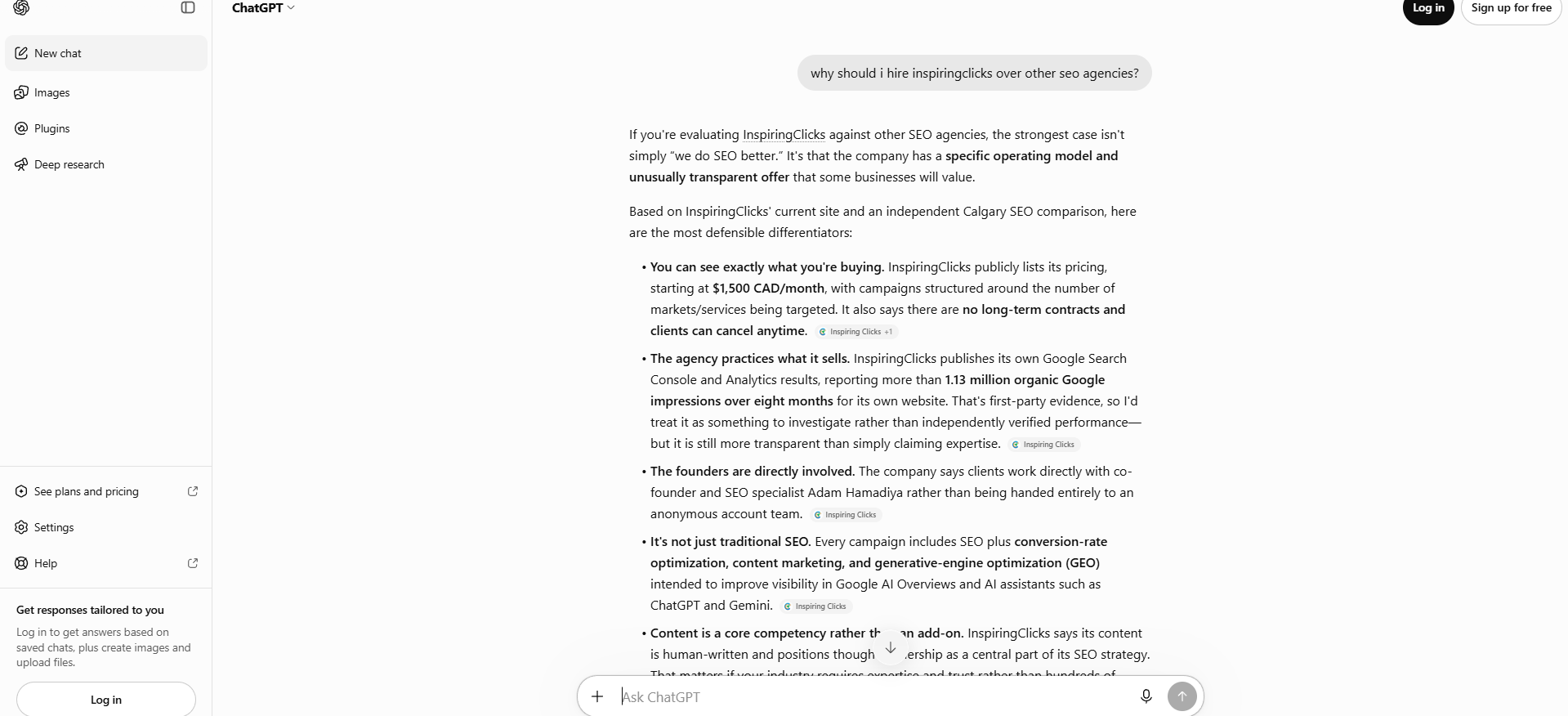
Rankings do not equal revenue. Revenue is a product of sales. When a website communicates value, reduces uncertainty and makes the next step obvious for visitors, it makes it easy for them to take action. The process of improving that journey is called conversion rate optimization (CRO), and it is so important that InspiringClicks includes it in alongside Calgary SEO services.
Conversion rate optimization is the process of increasing the percentage of visitors who take a valuable action. It is done by studying how people move through a website, identifying friction and testing improvements to messaging, page structure, calls to action, forms, mobile usability and checkout flows. CRO is directly tied to SEO business outcomes because traffic only becomes valuable when people act.
For example, by understanding where visitors drop off in a conversion funnel, you can identify where friction is occurring and implement fixes that make the next step easier to complete. Lost conversions are often the result of simple but easy-to-miss usability problems. For ecommerce specifically, A site could improve its conversion rate by as much as 40% through checkout design improvements alone.
Getting traffic is one thing. Turning that traffic into customers is another. Make sure that you are optimized for both search engines and conversions.
You should not have to wait six months to find out whether your SEO company is making progress.
There are measurable signs at every stage of the SEO process that show whether your SEO is working. These stages are deeply connected to the way Google discovers, indexes and ranks content. The timeline varies from agency to agency, but in our experience the sequence is usually consistent.
We implement fixes and publish useful content. Google crawls and indexes those pages, increasing the number of pages from your website that can be found in search.
More indexed pages create more opportunities to appear for relevant searches. An impression is counted when your page is shown in Google search results.
As pages gain impressions and rankings improve, they can earn clicks. You cannot receive a search click without first receiving an impression because the searcher must see the result before choosing it.
Qualified visitors reach your website and take action by calling, booking, submitting a form or purchasing. This is where search visibility can become revenue.
The purpose of SEO is to increase qualified search visibility, attract potential customers and generate business that produces a return on investment.
Traffic without business outcomes is not enough. Rankings, impressions and clicks are useful because they show whether the SEO process is progressing, but the commercial objective is to turn that visibility into measurable actions such as calls, form submissions, bookings and purchases. SEO that produces traffic without qualified leads or sales may be visible, but it is not creating the business outcome the campaign was designed to achieve.
Three-year average ROI reported from thought leadership-based SEO campaigns varies significantly by industry. The figures below are benchmarks, not guarantees.
ROI = net profit from the SEO campaign ÷ SEO campaign costs. Source: First Page Sage
SEO is effective because it connects a business with people at the moment they are actively searching for information, products or services. Nearly every online journey touches search in some form, and Google alone held 91.1% of the worldwide search-engine market in August 2026. AI search adds another discovery layer by retrieving, organizing and synthesizing information for users.
Google describes its mission as “to organize the world’s information and make it universally accessible and useful.” The web contains an enormous amount of that information. SEO helps make your portion of it accessible, understandable, relevant and useful enough to be discovered by the people looking for it.
Use Search Console to measure indexation and crawl-related issues, then track impressions, clicks, click-through rate and average position using data reported directly by Google. Third-party SEO platforms such as Ahrefs are valuable research tools, but their traffic and keyword estimates are not your first-party Google performance data.
Use GA4 to measure what visitors do after arriving. Key events can include form submissions, bookings, purchases and other lead actions, allowing search traffic to be connected to meaningful website outcomes.
With thoughtful form routing, event tracking and source data, different pages and campaigns can send leads into distinct workflows while preserving where the enquiry originated. That makes it possible to compare not only how many leads SEO creates, but which parts of the strategy create them.
The price of SEO in Calgary varies with the competitiveness of your market, the condition of your website, the amount of work required and the scope of the campaign. Some providers charge a monthly retainer, while others sell projects, hourly consulting or individual deliverables. Because the barrier to offering SEO services is relatively low, businesses can find freelancers charging only a few hundred dollars per month as well as agencies charging several thousand.
The more useful question is not simply “How much does SEO cost?” It is “What does that investment produce?” Does it increase qualified search visibility, generate enquiries and create customers—or leave you paying month after month without being able to see meaningful work or business progress?
At its core, SEO is about connecting the right people with your business when they are searching for what you offer. For that reason, the price of SEO in Calgary should reflect the work required to compete in your market and the value the campaign is capable of creating—not how cheaply someone can sell a list of SEO tasks.
Comprehensive SEO. Customized to your business.
The SEO services by InspiringClicks is both targeted and strategic. Each product or service you want to get found for requires its own attention. For example, if you want to get more visibility for basement renovations in Calgary, you cannot market for kitchen renovations and expect to get found for basement - the search intent are different for both, and therefor, they are two different markets. Every SEO campaing delivers core SEO principles to help you tap into that market, but our packages differ based on the number of markets you want to capture.
You can hire InspiringClicks by getting in touch or choosing a package below. Our packages are tiered by the number of markets or services you want to get found for. Select the number of targeted campaigns you want below and leave the rest to our professionals. Choose monthly billing or pay six months upfront and save 10%.
About the Google Ads add-on: Google Ads can bring paid search visibility while your SEO campaign builds organic visibility. Adding Google Ads here does not charge you for advertising at checkout; ad spend and management fees are arranged separately.
Google Ads and SEO are two different ways to reach people searching for your services. Ads can put your business in front of customers as soon as a campaign is approved and running. SEO builds your presence in unpaid search results over time. Used together, they can support both immediate demand and long-term growth.
Think of paid search as renting visibility and organic SEO as building an asset. With Google Ads, you pay for eligible clicks and can adjust your reach with your budget. With SEO, you invest in pages, technical improvements, content and authority that may continue attracting visitors without a fee for every organic click. Organic positions are never guaranteed and still require upkeep.
When both SEO and PPC are used together, paid-search campaigns can quickly reveal which keywords, messages and landing pages generate qualified enquiries. Because Google Ads begins collecting impressions, clicks and conversion data as soon as ads run, those early results can help us prioritize the organic searches, pages and content most worth investing in. On the other hand, growing organic traffic through SEO can reduce how heavily your business depends on paid clicks for the same searches. That does not automatically lower the price Google charges per ad click, but it can lower your blended cost of acquiring traffic and leads, allowing you to save advertising budget or reinvest it in new keywords, services and markets.
Google Ads can generate sponsored visibility while your organic campaign is being built. You control the targeting and budget, and pay for the traffic your ads receive.
SEO works toward relevant rankings, useful pages and a stronger website that can attract qualified visits without a per-click advertising fee.
Search is changing, but the most useful SEO advice often starts outside a keyword tool. Here are three principles that guide how we think about making Calgary businesses easier to discover, distinguish and remember.
AI Overviews and other search features compete for attention on the results page. That makes SEO about more than winning a blue-link ranking: it is also about building a brand people can recognize, trust and remember. Brands give customers a way to distinguish one business from another. They also give search engines and AI systems a consistent identity to associate with information about your business, although no specific AI citation or ranking is guaranteed.
Bring the qualities people experience in real life onto your website. What does your team do differently when serving Calgarians? What problems do you solve every day, and what can you show rather than merely claim? Turn those answers into specific service stories, original photos, examples of your work, customer questions, and evidence of how you operate.
Most businesses have information that never makes it onto their websites. It lives in job records, service appointments, customer conversations and the decisions their teams make every day. Those details can be more useful to a prospective customer than another polished overview of a topic already covered by hundreds of sites.
For example, a Calgary renovation company could review its completed projects to explain which factors actually changed the final cost, which delays came up most often, and what homeowners wished they had asked before work began. A mechanic might share patterns found across common vehicle repairs. These findings are grounded in work the business has performed, rather than estimates assembled from other websites.
AI tools can help organize and explain that material, but they cannot independently verify records they have never accessed. When you publish useful findings with clear context, methodology and appropriate privacy protections, you give customers—and potentially search and AI systems—a reason to reference your business as a source. Unique data alone does not guarantee rankings; it must answer real questions accurately.
Customers can encounter your business through organic listings, sponsored ads, Google Business Profile, videos, social discussions and AI-generated answers. Search results increasingly bring several of those formats onto one page. AI features can also surface information from sources such as websites, videos and public discussions, depending on the query.
That is why SEO should inform—and be informed by—other marketing channels. A Google Ads campaign can reveal which messages earn qualified enquiries quickly; organic content can answer the questions people ask before buying; and useful videos or credible third-party mentions can give people more ways to encounter your business. Repeated exposure across relevant channels may improve recognition and increase the chance of a later branded search or visit, but it is not a guaranteed click.
Different search experiences produce different kinds of visibility. Many searches end without a click, but that does not make every impression worthless: being seen repeatedly can help people recognize your business and search for it by name later. That is why building a recognizable brand matters across organic results, sponsored listings and AI answers. The chart below compares clicks and no-click searches; AI responses were not measured as a separate click destination in this study.
To choose the right SEO company, consult with several different providers. Ask each one the same questions, take notes, then compare their SEO approach, experience, and communication. This gives you a clearer basis for choosing a provider you feel comfortable working with.
A Calgary SEO agency may bring experience with local businesses, competition and how customers search for services in the city. Independent SEO consultants can work from anywhere in the world and may also bring transferable skills from other industries, markets and projects. Neither option is automatically better: compare how well each provider understands your business and explains what they will do.
To help you have a productive consultation, we’ve developed eight questions that will help you understand what you’re paying for, what results you can reasonably expect, and who will be responsible for delivering the work. We’ve also made the questions available as a printable worksheet, with space to record each company’s answers. Bring it to your consultations and use your notes to compare providers afterward.
You can start by booking an SEO consultation with InspiringClicks and putting these questions to us.
Both options include all 8 questions with dedicated writing space beneath each one.
Focus on what you do best.
Bring us your website, your goals and the markets you want to grow. We will tell you what we see, what we would prioritize and whether SEO makes sense for the opportunity.
Talk directly with our team about your search visibility.
SEO Consulting and Brand Building Agency
InspiringClicks is an SEO consulting and brand building agency offering marketing services, from consultations with world-renowned SEO expert Adam Hamadiya to content creation.