

SEO vs PPC: What’s the Difference and Which Should You Use?
SEO and PPC both exist to put a business in front of someone who is already searching for what it sells. The right choice depends on your timeline, your budget, and how zero-click searches affect your industry.
Table of Contents
- What Is PPC?
- What Is SEO?
- Should You Use SEO and PPC at the Same Time?
- Which Generates a Higher ROI, SEO or PPC?
- The Difference Between SEO and PPC
- What Do SEO and PPC Cost?
- Which Should You Choose, SEO or PPC?
- How Have Zero-Click Results Impacted SEO and PPC?
- AI Overviews Reduce Clicks on Paid Ads, Not Only Organic Results
- SEO and PPC Work Best When Used Together
- SEO vs PPC: Frequently Asked Questions
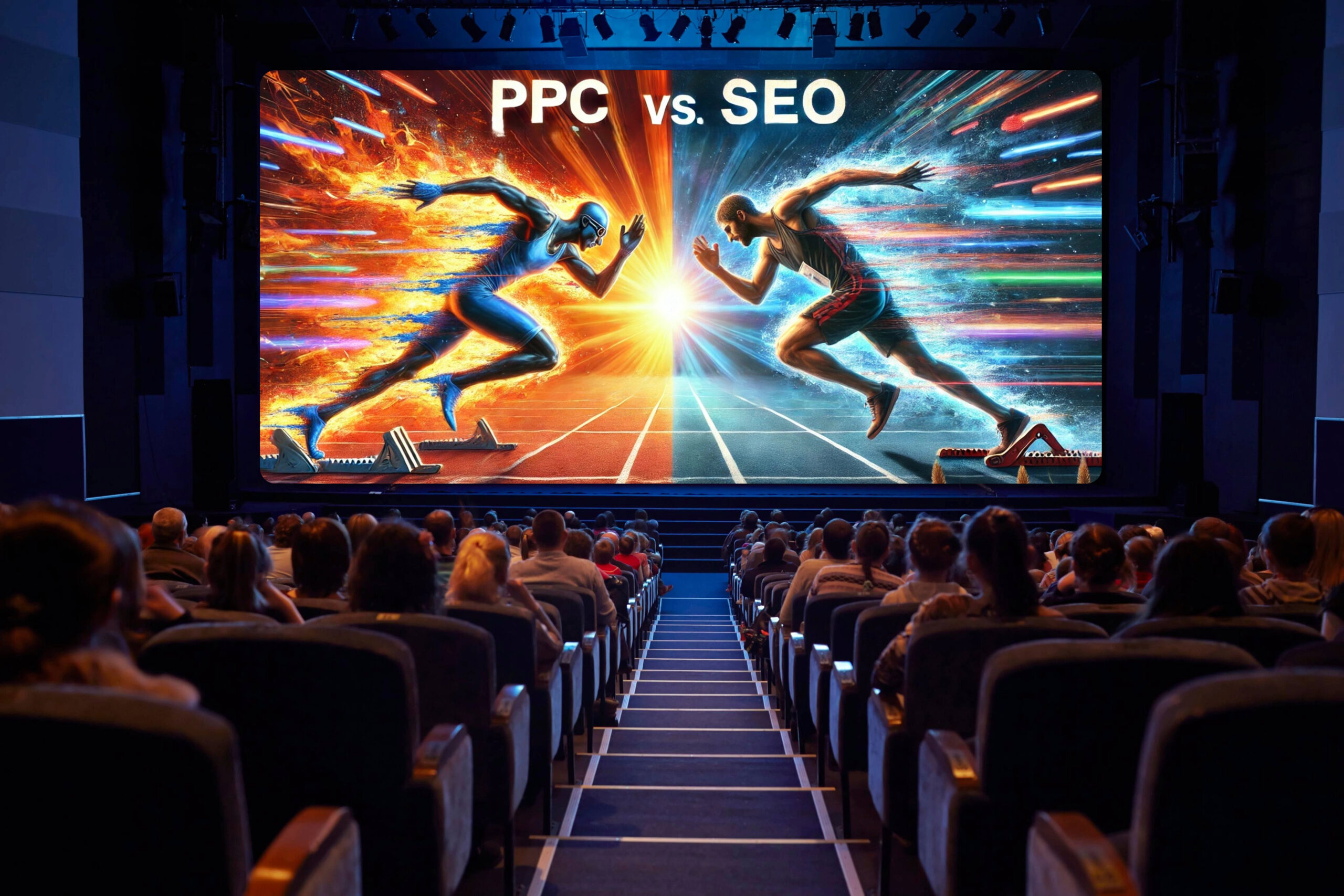
SEO generally returns more over a longer period and PPC returns faster over a shorter one, which is why the two are complementary rather than competing. PPC places a business on page one immediately and stops the moment the budget does. SEO takes months to compound, but the visibility it earns is not rented, and it is also what makes a business quotable to the AI assistants now answering a large share of searches without sending anyone to a website.
What Is PPC?
PPC, or pay-per-click, is advertising that places a business in Google’s sponsored results and charges a fee every time someone clicks the listing. The sponsored results are the placements sitting above and below the organic ones, marked as ads.
Position is bought rather than earned, which makes PPC the fastest route onto page one. A campaign can be live the day it is approved, on any keyword a business is willing to bid for, regardless of whether the website has any authority behind it. That speed is the whole appeal.
The trade-off is that the placement is rented. Every visit carries a cost, and the listing disappears the moment the budget is exhausted. A month of ads produces a month of leads, and nothing accumulates for the next month.
What Is SEO?
SEO, or search engine optimization, is the work of earning placement in Google’s organic results, which are the unpaid listings ranked on relevance and authority rather than on payment.
Organic listings are earned through relevance and authority signals rather than paid bids. No fee is charged per click, and the placement holds without ongoing payment, although it does require continued work to defend against competitors optimizing for the same terms. SEO covers content, technical performance, site structure, and the authority signals that make a page worth ranking.
The trade-off runs the other way from PPC. Nothing appears immediately: pages are typically indexed within weeks, impressions build over one to three months, and meaningful traffic generally arrives between three and twelve months. That upfront investment builds a permanent website asset rather than an ad placement that stops working when funding runs out.
Sponsored results
Rented from Google and charged per click. Immediate, and gone when the budget is. This is the half PPC covers.
Organic results
Earned from Google on relevance and authority. Slow to secure, and held without paying per click. This is the half SEO covers.
Should You Use SEO and PPC at the Same Time?
For most businesses, yes. SEO and PPC are not competing disciplines; they are the two halves of Search Engine Marketing, and a results page contains both. Running only one means competing for a share of one side of the page while leaving the other to whoever shows up.
Search engine marketing is the strategy that occupies both halves for the same search, which is why it is often described as search engine dominance. PPC captures leads immediately. SEO is the more sustainable channel with the higher return over the long term. Together, they are the complete search strategy.
How we approach it at InspiringClicks
We often run a dual strategy that uses SEO and PPC together. The idea is to rank on the first page of sponsored ads immediately while we build up SEO for long-term organic ranking.
This works well for two reasons. The first is that PPC produces data straight away, and that data can be used to cross-reference, verify, and optimize an SEO campaign further; you learn which keywords actually convert into bookings and sales before committing months of content to them.
The second is cost. Ranking for keywords organically reduces cost per click over time while producing more leads in the long term, because a business no longer has to pay for every click just to appear. Essentially, you own your space on Google instead of renting it.
Which Generates a Higher ROI, SEO or PPC?
SEO generally produces the higher return, but only once enough time has passed for it to compound; PPC produces the faster return, and that return stays roughly flat for as long as it runs. The two are measured over different horizons, which is why a single ROI figure covering both is misleading.
PPC returns are immediate and linear. Spend produces clicks, clicks produce leads, and the ratio between them is visible in the account within days. That makes paid search unusually easy to justify: the return is measurable almost at once. It also means the return does not improve on its own. Doubling the budget roughly doubles the leads, and the moment spending stops, so do the leads. Cost per click also tends to rise year over year as more competitors enter the auction, so holding the same return usually requires spending more over time.
SEO returns start negative and compound. Initial SEO work rarely generates immediate leads, as published pages take time to gain rankings. What changes the arithmetic is that the pages do not expire. A page ranking in month four is still ranking in month twenty-four without a further charge per click, so every additional month spreads the original cost across more leads and cost per acquisition falls. The content library also compounds against itself, since a site with established authority ranks new pages faster than a site starting cold.
There is an honest complication worth naming. SEO’s return has become harder to attribute, because a large share of the visibility it earns no longer produces a trackable click. A business named in an AI answer or a featured snippet may win the customer through a branded search days later, and analytics will credit that as direct or branded traffic rather than as the organic result that caused it. The return is real; the attribution is messier than a PPC dashboard, which is part of why paid search often looks better than it is in a side-by-side comparison.
The practical read is that PPC wins on payback speed and measurement, SEO wins on total return per dollar over a longer horizon, and a business running both gets the immediate return while the compounding one builds underneath it.
The Difference Between SEO and PPC
PPC buys immediate visibility in paid ad slots, while SEO builds the organic authority required to rank naturally. Every other difference between the two channels follows from that.
- PPC: Placement in the sponsored results is bought outright. Position is immediate and is held only for as long as the account is funded; when spending stops, the listing is removed.
- SEO: Placement in the organic results is earned on relevance and authority. The position persists without paying for the click, although it does require ongoing work to defend against competitors optimizing for the same terms.
SEO vs PPC Comparison Chart
| Factor | SEO | PPC |
|---|---|---|
| Time to first results | Pages indexed within weeks, impressions building over one to three months, meaningful traffic between three and twelve months. | The same day the campaign is approved. |
| What the money buys | Content, technical work, and authority that stay on the domain permanently. | Clicks. The asset is the campaign data, not the placement. |
| What happens when you stop | Rankings hold for a period, then erode as competitors keep investing. | Visibility ends immediately. |
| Cost trajectory | Cost per acquisition falls as the content library compounds. | Cost per click has risen year over year and continues to. |
| Exposure to zero-click search | High on informational queries, though SEO is also the only route into AI Overview citations. | Also high. Paid CTR fell further than organic on AI Overview queries. |
| Effect on AI search visibility | Direct. AI assistants cite content, and content is what SEO produces. | None. Ads are not cited by AI assistants. |
| Best use | Long-term authority, compounding lead volume, and being the source AI answers quote. | Launches, seasonal demand, testing a market, and covering the gap while organic visibility is built. |
Table created by InspiringClicks.
What Do SEO and PPC Cost?
Most SEO vs PPC articles compare the two in the abstract, which is not much help to someone deciding where a budget goes. LocaliQ’s 2026 benchmark study, drawn from more than 13,000 US search campaigns across 23 industries between April 2025 and March 2026, puts the all-industry averages at a 6.64% click-through rate, a $5.42 cost per click, an 8.18% conversion rate, and a $66.69 cost per lead.
| Industry | Average CPC | $1,500 in ad spend |
|---|---|---|
| All industries | $5.42 | ≈ 277 clicks, ≈ 22 leads |
| Attorneys and legal services | $9.87 | ≈ 152 clicks, ≈ 12 leads |
| Home and home improvement | $8.33 | ≈ 180 clicks, ≈ 15 leads |
| Restaurants and food | $2.05 | ≈ 732 clicks, ≈ 60 leads |
| Arts and entertainment | $1.63 | ≈ 920 clicks, ≈ 75 leads |
Table created by InspiringClicks. CPC data from the LocaliQ and WordStream 2026 Google Ads benchmarks. Lead estimates apply the 8.18% all-industry conversion rate and exclude management fees; a business converting above or below that average will land somewhere different.
First, the auction has moved significantly: average CPC has more than doubled in a decade, and it continues to climb as organic click share compresses and more businesses move into paid. Second, the leads stop when the spending does. A month of ads produces a month of leads.
The honest comparison against SEO is not month one; it is month twelve. In the first month an equivalent SEO budget produces published pages and no leads, and paid ads win outright. By the end of a year those pages are still indexed, still ranking, and still owned by the business.
What we charge, for comparison
Our SEO campaigns start at $1,500 per month and our PPC management from $200 per month plus a $497 one-time setup fee. When both PPC and SEO are used together, they create the ultimate Search Engine Marketing (SEM) strategy.
Which Should You Choose, SEO or PPC?
The answer depends on where a business currently stands. The quiz below weighs five factors and explains the reasoning behind each one.
SEO or PPC: Which One Should You Use?
Five questions on where your business stands right now.
Question 0 of 5
1. Does your website currently get organic search traffic?
2. Are you launching something or expecting a seasonal spike within the next year?
3. Which would you rather have for your business?
4. Are you satisfied with the content on your website?
5. Does your business get mentioned when someone asks ChatGPT, Gemini, or Google’s AI Overview for a recommendation in your industry?
Quiz created by InspiringClicks
How Have Zero-Click Results Impacted SEO and PPC?
68.01% of US Google searches are now zero-click, according to SparkToro's study of Similarweb clickstream data, up from 60.45% two years earlier. That means roughly two out of three searches end on the results page itself: the searcher reads an AI Overview, a featured snippet, a map pack, or a knowledge panel, gets what they came for, and never visits a website.
For every 1,000 US Google searches in 2024, 374 clicks reached the open web. Two years later, that figure is 276.
Open-Web Clicks per 1,000 US Google Searches
| Year | Open-web clicks per 1,000 searches | Zero-click rate |
|---|---|---|
| 2024 | 374 | 60.45% |
| 2026 | 276 | 68.01% |
Chart created by InspiringClicks. Data from SparkToro and Similarweb, June 2026 (US desktop and mobile web panel, January to April 2026). The 2024 baseline came from a different panel, so the two years are directionally comparable rather than exactly matched.
This affects SEO because a first-place ranking no longer guarantees a visit. A page can gain impressions month after month while clicks stay flat, since Google increasingly answers the query above the result rather than sending anyone to it. SparkToro attributes most of the recent acceleration to AI Overviews, which now appear on more than 20% of searches and cut click-through rate by roughly 60% when they do.
It affects PPC because a smaller pool of searchers ever scrolls far enough to see an ad, and advertisers bid against each other for what remains. That pressure shows up in the auction: the all-industry average cost per click has climbed to $5.42, against $2.32 a decade ago. Fewer available clicks, at a higher price, purchased with the same budget.
Do Zero-Click Searches Mean No Clicks at All?
No; a zero-click result frequently produces a click in a different form. An AI Overview or a snippet might name a business as the answer, and the searcher then types that business name into Google as their next query. The zero-click result has transformed a service search into a branded search, and a branded search still leads to the website. The click was not lost, it was deferred and relabelled.
For search engine marketing, this means the visibility that produced no click is still doing work, and the measurement has to follow it. Impressions, citations in AI answers, and growth in branded search volume are now leading indicators that sit ahead of the click in the sequence. A campaign judged only on organic sessions will look like it is underperforming at precisely the moment it is building the recognition that produces the next search.
How Should You Adjust Attribution for Zero-Click Search?
The structural problem is that a zero-click impression is a touchpoint no attribution model can see. Multi-touch models work by joining sessions to a user, and a search that ends on Google produces no session to join. So the first touch in the journey — the AI Overview that named the business, the snippet that answered the question — is invisible to the model, and the branded search that follows arrives looking like the origin of the journey rather than its second step. Last-click attribution handles this worst of all, since it hands the entire conversion to a branded query or a direct visit and credits nothing to the organic work that caused either one.
Three adjustments cover most of the gap. The first is to separate branded from non-branded queries in Search Console and track them as distinct lines, treating growth in branded search volume as a downstream outcome of upstream visibility rather than as demand that appeared on its own. The second is to move off last-click to a data-driven or position-based model, which at least stops a branded query from absorbing credit that belongs earlier in the sequence, while accepting that no model recovers a touchpoint that never generated a session. The third is to feed the missing touchpoint in from outside the model, using impressions, AI citation tracking, and share of voice as the upstream measures the analytics platform cannot supply.
Where a channel's contribution genuinely needs proving rather than estimating, incrementality testing is more reliable than any attribution model: pause a channel in one region or for a defined period and measure what happens to total conversions, rather than asking a model to divide credit it does not have the data to divide. It is a blunter instrument, and it answers the question the model cannot.
A keyword's search volume no longer describes the traffic available from it, which is exactly the reason our forecasting article busts the most common estimate in the industry. How do you predict SEO results? takes apart the assumption that expected traffic equals monthly search volume multiplied by click-through rate, because not all searches lead to clicks. The zero-click data above is the measured version of that same point. Worth being precise here: the argument is not that SEO recently became harder to forecast. Forecasting was never accurate, because forecasting is estimation by nature; what has changed is that the gap between the estimate and the result is now wider and easier to demonstrate, which is why the forecasting method that works starts with search data, matches intent, and then validates against the site's own performance once content is live.
AI Overviews Reduce Clicks on Paid Ads, Not Only Organic Results
The common assumption is that AI Overviews are an SEO problem and that advertisers are insulated from them. The measurement does not support that. Seer Interactive tracked 3,119 informational queries across 42 organizations from June 2024 through September 2025, covering 25.1 million organic impressions and 1.1 million paid impressions. On queries where an AI Overview appeared, organic click-through rate fell 61%, from 1.76% to 0.61%. Paid click-through rate fell further: 68%, from 19.7% to 6.34%.
Data from Seer Interactive's AI Overview CTR study. Seer's study lead notes the citation figures show correlation rather than proven causation, since brands with stronger authority may be both more likely to be cited and more likely to be clicked.
The same study found that brands cited inside an AI Overview earned 35% more organic clicks and 91% more paid clicks than brands that were not cited on the same results page.
Ad budgets buy fewer clicks on queries where Google shows an AI answer. Because cited brands capture most of the clicks that remain, ad performance now depends heavily on your organic authority.
Ranking well does not automatically produce that citation, either. Ahrefs found that 38% of AI Overview citations came from pages ranking in the organic top ten, down from 76% eighteen months earlier, while BrightEdge put the overlap closer to 17% using a different dataset. The studies disagree on magnitude and agree on direction: a page-one position has become a weaker predictor of AI citation than it was, which is why optimizing for AI answers is now a separate discipline rather than a by-product of ranking.
SEO and PPC Work Best When Used Together
Running both is not a hedge. The two channels feed each other in ways neither produces alone. PPC delivers leads while organic rankings are still building, and as those rankings arrive, the terms can be dropped from the ad account and that budget moved to keywords the business does not yet own. Effective cost per click falls because fewer clicks are being paid for.
The direction that matters more runs the other way. Because brands cited in AI Overviews earn substantially more paid clicks than uncited brands on the same results page, the editorial work that earns a citation is now improving the return on the ad account. Ad spend is no longer independent of content quality, and the same relationship applies to who is writing that content: AI assistants cite sources they can attribute expertise to, and material assembled from what already exists gives them nothing distinctive to quote.
| What happens | Why it matters |
|---|---|
| PPC covers the gap while SEO builds | Revenue arrives from month one rather than month six, which is what makes the longer SEO timeline affordable. |
| Ad spend moves off terms that start ranking | The same budget reaches keywords the business has not earned yet, so cost per acquisition falls over time. |
| PPC conversion data directs content strategy | You learn which terms produce paying customers before committing months of content to them. |
| Organic authority improves ad performance | Brands cited inside AI Overviews earn 91% more paid clicks than uncited brands on the same query. |
| SEO holds the ground ads cannot reach | There is no paid placement inside an AI Overview or an assistant's answer; that visibility is only earned. |
Table created by InspiringClicks.
Rank now with ads while we build your SEO
SEO campaigns from $1,500 per month and PPC management from $200 per month plus a $497 one-time setup fee.
- Higher ROI
- Lower cost per click
- You own your ranking instead of renting it
SEO vs PPC: Frequently Asked Questions
What are SEO and PPC called together?
Search Engine Marketing, or SEM. PPC covers the sponsored half of a Google results page and SEO covers the organic half, so SEM is the strategy that competes for both positions on the same search rather than one of them.
Is SEO or PPC better for a small business?
PPC is usually better for a small business that needs revenue this quarter, and SEO is better for one that can fund a longer runway. Most small businesses do best running a small paid campaign for immediate leads while investing the larger share in organic and AI search visibility, because ad costs rise every year while content assets accumulate.
Does SEO still work now that most searches end without a click?
Yes, though the measure of success has shifted. Traffic volume is a weaker indicator than it was, because 68% of US Google searches now end without a click. Local, branded, and high-intent transactional searches still produce clicks, a zero-click result often converts a service search into a branded search that does reach the website, and SEO remains the only route into AI Overview citations.
How much does PPC cost compared to SEO?
Ad spend and agency fees are separate costs. On ad spend, the all-industry average cost per click in Google Ads is $5.42, ranging from $1.63 in arts and entertainment to $9.87 in legal services, at an average cost per lead of $66.69, and that cost recurs for every click. On fees, InspiringClicks SEO campaigns start at $1,500 per month and PPC management from $200 per month plus a $497 one-time setup fee, with ad spend paid directly to Google.
Do AI Overviews affect Google Ads?
They do, and by more than they affect organic results. Seer Interactive measured a 68% drop in paid click-through rate on queries where an AI Overview appears, against a 61% drop for organic. Brands cited inside the Overview earned 91% more paid clicks than uncited brands on the same page, which means organic authority now influences ad performance.
Can you run SEO and PPC at the same time?
Yes, and for most businesses that is the more effective approach. Ads produce leads while rankings build, paid conversion data shows which keywords deserve content investment, and ad spend can be redirected as organic rankings take over the terms it was covering.